

Start a Conversation to Help Your Boss See Your Genius and Recognize Your Skills
You want your boss to see your genius. But what if they don’t? How do you communicate your worth to get the recognition, support, and advocacy you need? And how do you do it without looking needy?
One tool you receive when you participate in our foundational leadership development program is the Confidence Competence Model. It helps you to target your coaching and development efforts to what each person on your team most needs. A decade of leading high-potential leadership programs around the world confirms—people who are good at what they do (and know it), yearn to be seen and challenged. Read more about retaining top performers here.
How to Get Your Boss to See Your Expertise

If YOU identify as a “Challenge Me” employee, in the high-competence, high-confidence category, it’s likely you also want your boss to SEE YOUR GENIUS, and challenge you to bring more of that into your current and future roles.
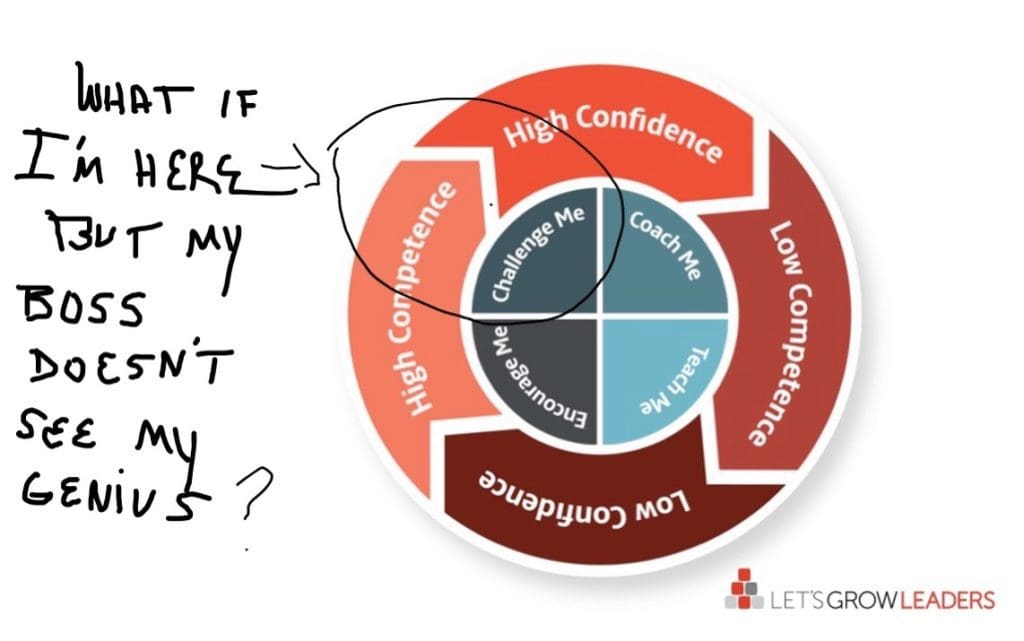 But what if your boss DOESN’T get it? What if your genius isn’t something they value?
That’s not easy. And there is hope. One of the favorite parts of our jobs is helping people unleash and apply their genius.
Start by getting curious about their perspective.
Start by putting pause on your frustration and show up a bit curious about their perspective.
1. Get Curious About Tommy Syndrome
If you’ve been around for a long time, maybe there’s some “Tommy Syndrome,” happening. You joined your company as a kid (Tommy). Now you’ve matured into a high-performing, mature leader, but your well-meaning boss, who has known you from the beginning, can’t see the (Tom) you’ve become.
2. Get Curious if They “Get It”
Or it could be you have technical expertise that they just don’t understand. Or maybe they don’t value what you do.
I (Karin) had a boss who thought I lacked the business savvy for leading a B2B sales organization. “Oh, Karin, sure you’re team is leading the Nation in SMB (small and medium business sales), but selling to Enterprise customers is completely different.” If I can be so bold, he didn’t see my genius. I gladly accepted a promotion outside of his organization, as they wanted exactly the skills he couldn’t see.
Of course, now I’m not only the founder and CEO of a successful, International human-centered leadership company with large Enterprise clients around the world, but we also designed and built all the products. I wish I had this article back then to help him with his lack of imagination 😉 And gosh, I hope he reads this on Linkedin.
I (too) David, had a boss who never quite understood or valued all that I did in his organization. To be fair, he greatly valued and relied on some of the technical aspects of my work. But when it came to leading a diverse workforce with widely varying experiences and perspectives, many of whom had challenging life circumstances, I knew he hadn’t fully seen or valued my leadership. Two months after I’d left the organization he sent me a text one night that read simply, “I had no idea how much you did here.”
3. Get Curious About the Overwhelm
It could be that your boss is just too busy or overwhelmed to see your genius, and needs your help to point it out. Honestly, this is a best-case scenario. Overwhelmed managers often really want to pay attention to the areas of their role (like investing in leaders) that they don’t have time for. The conversation starters below will help them exhale and help you advocate for what you need.
4. Get Curious About How You Can Grow
And, of course, maybe they have an important perspective you really need to pay attention to. Perhaps they see blind spots that keep you from being your best. Maybe a lack of performance in an area that’s critical to your department’s success undermines what see as your genius. If you don’t have the basics covered (as your manager sees them), it can be challenging for them to see where you shine.
Beginning the conversation with a bit of curiosity is an important first step.
A Few Conversation Starters To Inspire Attention to Your Genius
 As you show up with curiosity, here are a few conversation starters to uncover opportunities and understand their perspective. The key here is to ask for specific insights. “How am I doing?” or “Is there anything I should change?” can feel vague and overwhelming. Instead, here are some good options:
- I care deeply about this company and I want to make as big of a contribution as possible. I’d love to hear your thoughts on one way I can add additional value to the team.
- As we head into the next three months, I’m curious about what you see as one of my biggest strengths to build on, and one opportunity to grow.
- I’m curious about what an extraordinary year would look like for my role from your perspective. What specifically do you see me doing now that will contribute to making that happen? And, what’s one thing I should consider doing differently?
- What do you see as the top three strengths I bring to the team? How do you think I could contribute more in that arena?
Use Strategic Stories to Showcase Your Genius
Once you’ve learned their perspective and looked at the opportunities they see for you, it’s time to speak up for the characteristic that you don’t think they see or value. One way to do this is to learn the art of a strategic story. If your genius is turning around disgruntled customers, weave in a casual story the next time you’re together about the customer, what happened, what you did, and the difference it made.
If your genius is developing your team, talk about what you’re doing and the difference it’s making. One way to make this feel less awkward is to frame that story as recognizing a team member.
“I’ve got to tell you about how amazing Paul is doing with his sales close rate. We’ve been working really hard on his opening and closing statements, and he’s really nailing it!”
Powerful Phrases to Ask For What You Need and Highlight Your Genius
These phrases can help to open the door for better executive exposure and opportunities to showcase your and your team’s work.
- I’d love to give you an opportunity to learn more about my team and the work that we do. Can we set up some time to do that?
- I’ve been working on ___________ and I know how important this is to our overall strategy. Can we carve out a few minutes in an upcoming staff meeting so I can give you and the team some updates?
- With all the remote work in the last few years, I wonder if we’re missing opportunities to really know one another and what we each bring to the team. What if I organized some time in an upcoming meeting where we could each talk about the biggest strength we bring to the team?
- I’ve always been proud of my ability to __________. And, sometimes I don’t feel I get a chance to do that as much as I would like here. Do you see more opportunities for me to use that skill here?
Once you’ve shown up curious and asked for an opportunity to showcase your skills and accomplishments, another approach is to get a bit more direct and ask for exactly what you need.
- I’ve got to tell you, I think I’m pretty good at ________. I would love an opportunity to show you by ________.
- I know you haven’t had much opportunity to see my ability to ______. What if I took on _______ (a special project, a pilot of an idea).
- I really think I’m ready for _______. What concerns would you have with me taking that on?
Your Turn
When you feel like your manager doesn’t see or value that aspect of your work where you feel you’re a superstar, begin with curiosity. Pay attention to what might obscure your unique value and where they see opportunities to grow. Once you’ve learned their perspective, use strategic stories to frame your abilities and ask for what you need.
Now it’s your turn – we’d love to hear from you: Was there a time when you felt like your boss just didn’t get it? What did you do? Were you able to transform the situation?





I feel like my boss doesn’t know me much. She is new & doesn’t know what I did for the company. She doesn’t pay attention to our supervision meetings & ignore my emails on certain problems I come up with. I requested few meetings which were overlooked & this is my final request for a meeting. She agreed to meet. How should I start my conversation? I want to say that I would like another openion on my decision when it’s hard to manage my problem. How should I put it without offending this boss ?
I read all your strategies &
Thanks for your help in advance!
Shiromi, Thanks so much for writing, and I’m so glad that you took the courage and perseverance to schedule time with your manager. I would definitely start with connection. Express how much you care about the company, and making an impact. Since she’s new, that’s a great place to start getting curious. How have things been so far for her, what can you do to support her? And then I would get very specific about what you could use for her and why it matters. For example, “what I could really use your advice, advocacy on ______(ask specifically for what you need).
And then talk about the best way to communicate in the future (could you set up a one-on-one, or establish team email protocols?
https://letsgrowleaders.com/2022/08/01/email-best-practices-how-to-send-a-better-more-effective-email/
My other thought is that it might be your boss is feeling overwhelmed with the new role and may have pressures she hasn’t fully communicated. This article might be useful too. I would love to hear how it goes. https://letsgrowleaders.com/2020/04/09/how-to-get-support-you-need-when-your-boss-is-overwhelmed/