
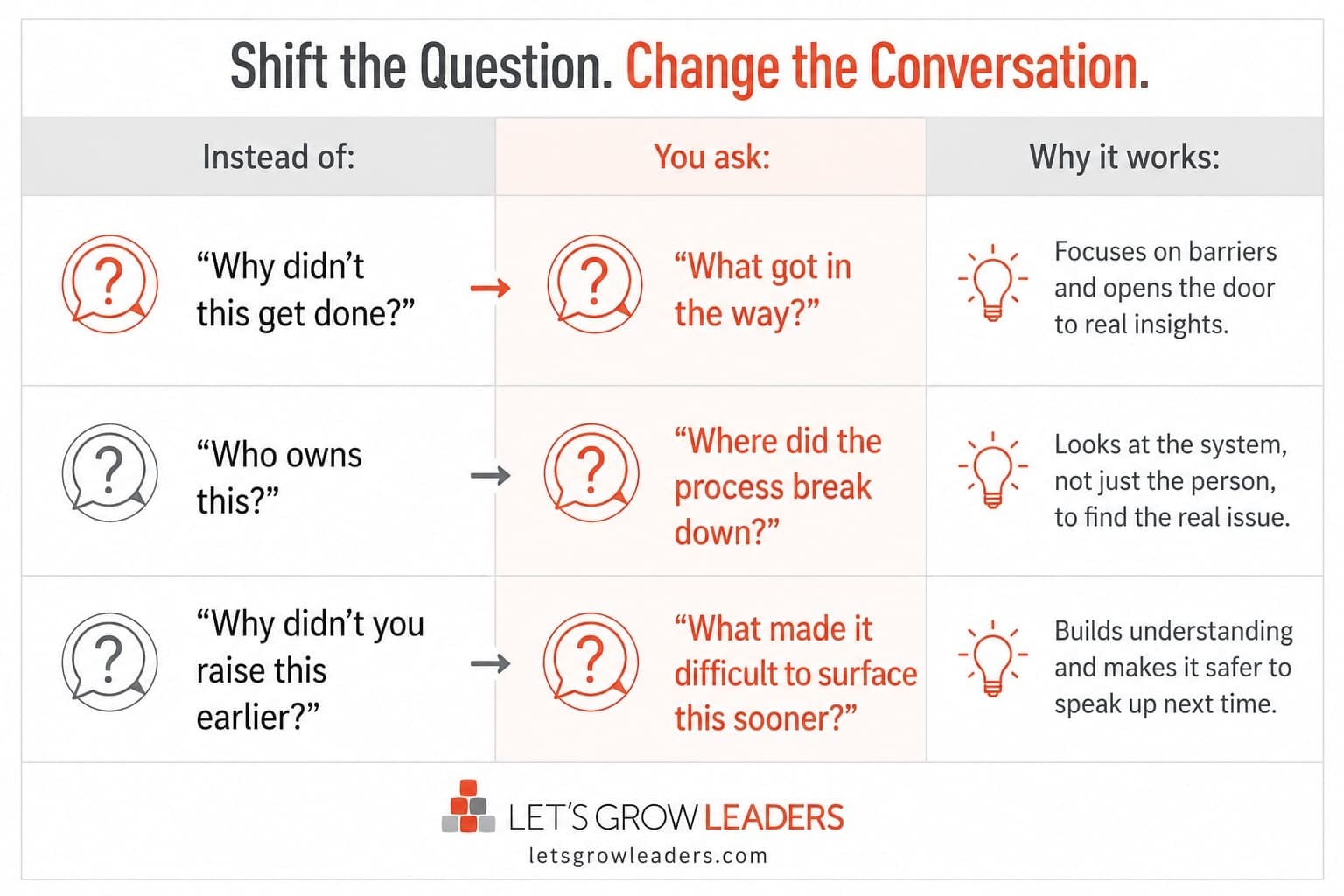
Blame Culture Looks Like Accountability—Until It Isn’t
You don’t need to look far to find signs of a blame culture.
Symptoms of a blame culture show up in project reviews, post-mortems, and everyday conversations where the focus quickly shifts from genine curiosity to:
- Who caused this?
- Why wasn’t this handled?
- Who owns the miss?*
Quick aside: The “who owns the miss” question still gives me (Karin) hives 😉 I heard this asked in the most intimidating tone possible, in more executive operations reviews than I can count. Of course, in complex gazillion-dollar projects, the answer is rarely a simple, “Oh, yeah, it’s Joe’s fault.”
On the surface, these questions look like accountability.
In practice, it limits how much truth you get—and how much you can improve.
Because once a conversation feels like blame, people stop sharing what really happened.
They edit.
Protect themselves and others.
Stay close to what feels safe.
And now you’re making decisions based on partial information.
Why Blame Cultures are So Common
Blame cultures persists because they create speed.
Blame gives the appearance of control:
- Identify the issue
- Assign responsibility
- Move on
But that efficiency comes at a cost.
You address the visible mistake and miss the underlying conditions:
- Competing priorities that were never reconciled
- Assumptions that went unchallenged
- Processes that no longer match reality
The issue shows up again—just in a slightly different form.
So the cycle repeats.
More pressure, scrutiny, and emphasis on getting it “right” the first time.
Less willingness to surface what’s actually going on.
Blame is one of the toxic, courage-crushing behaviors we found in our research for Courageous Cultures– once blame starts, people move into self-protection mode and conversation shuts down. Blaming leads to “safe silence.
Better Questions Expand the System
Most leaders don’t intend to create blame. But intent doesn’t determine how a question lands—context does. If you want better results, the work is to expand what you can see through better questions.
You Can’t Ask Better Questions in a Fear-Based System
This is where many leaders get stuck.
They focus on improving their questions—while leaving the surrounding environment unchanged.
But if people are dealing with:
- Public criticism or shaming
- Decisions made before input is considered
- Signals that it’s safer to stay quiet
They’re already spending their energy managing risk.
And when that happens, curiosity disappears.
In our research, people consistently described using their “courage reserves” just to navigate difficult leaders or avoid being blamed—leaving little energy for innovation or problem-solving.
So the shift away from blame culture isn’t just about language.
It’s about reducing the perceived risk of telling the truth.
Understanding Is Only Step One
Better questions improve the quality of information.
They don’t, on their own, improve results.
The second step is turning that insight into clear action.
That requires discipline:
- What needs to change?
- What will we do differently next time?
- Who is responsible for that change—and by when?
Without that step, even the best conversation becomes an interesting discussion with no impact.
The Signal That Matters Most
People don’t decide whether to speak up based on the question you ask.
They decide based on what happens after they answer.
If the response is:
- Dismissive
- Frustrated
- Quickly redirected
They adjust.
If the response shows:
- Consideration
- Follow-through
- Willingness to act
They lean in.
Over time, those moments shape whether people contribute—or stay quiet.
A Practical Place to Start
Download FREE sample chapters
In your next conversation where something isn’t working, shift your focus:
From: proving a point
To: understanding the system
Then ask one question that helps you see more than you could before.
You don’t change blame culture through a declaration.
You change it through consistent, observable behavior—especially when the pressure is high.
That’s what creates the conditions for better thinking.
And better results.



0 Comments