
A Courageous Culture Framework for Leading AI Change
AI is changing work faster than most organizations are prepared to lead through.
Your employees can feel that gap.
Some people are experimenting aggressively without enough safeguards. Others are hesitant to engage at all because they’re worried about making mistakes, damaging trust, or losing relevance. Managers are trying to interpret evolving expectations while still delivering results.
In moments like this, your employees are looking to leadership for more than strategy. They’re looking for clarity, curiosity, and confidence.
That’s why leading AI change well requires more than a technology rollout. It requires a Courageous Culture.
In our Courageous Cultures research, we found that employees are far more likely to innovate, solve problems, and speak up when leaders consistently create the conditions for contribution.
Those same leadership practices matter even more during fast-paced, rapidly evolving change, such as AI transformation.
1. Navigate the Narrative

Right now, your employees are telling themselves stories about AI.
Some are optimistic:
“This could help me work smarter.”
Others are worried:
“This tool is going to replace me.”
“Leadership cares more about efficiency than people.”
“I’m already behind.”
If you don’t actively shape the narrative, people will create their own.
That means being honest about both the opportunity and the uncertainty.
Talk specifically about:
- why AI matters to your business,
- where you believe it can help,
- what concerns you’re watching carefully,
- and why human judgment matters.
The goal is thoughtful engagement grounded in trust.
2. Create Clarity
One of the fastest ways to create fear and inconsistency is to require large scale AI adoption before people understand what good use looks like. 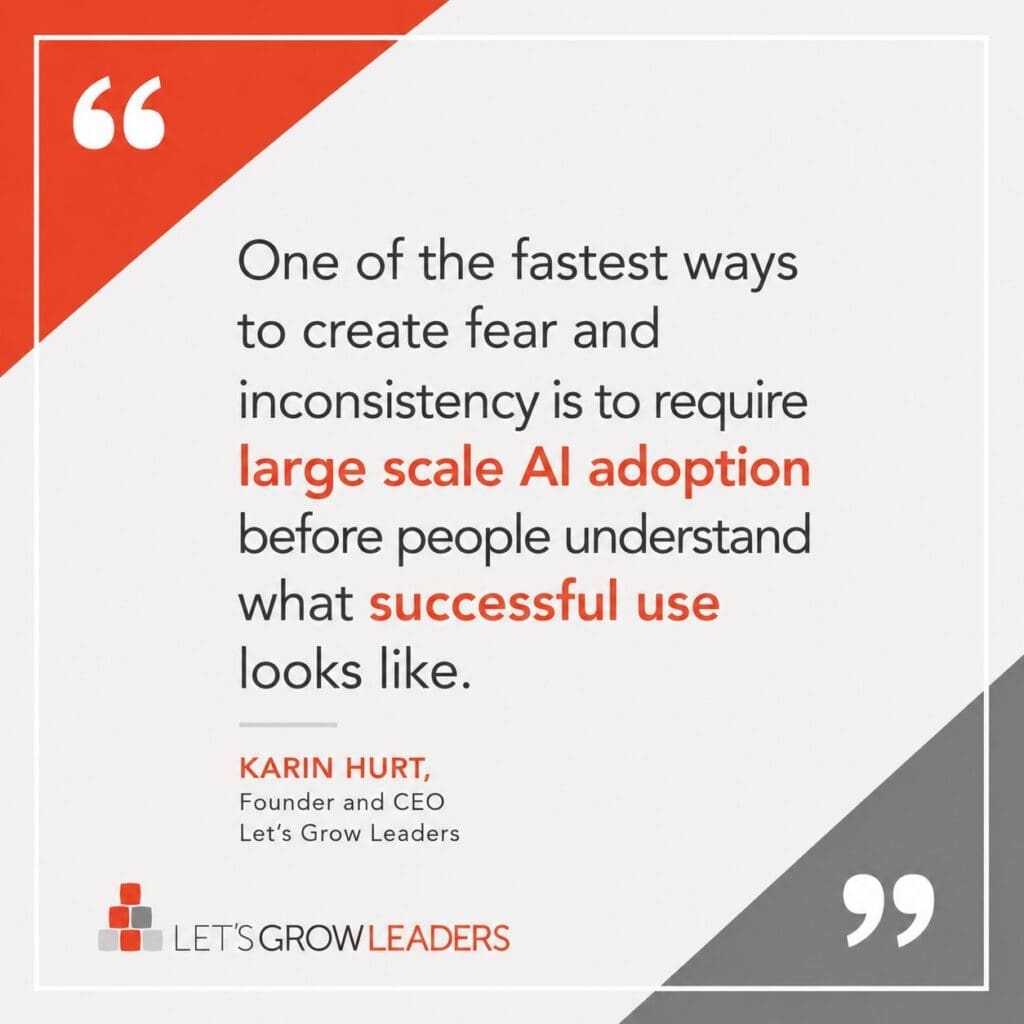
Your employees should not have to guess:
- when AI is appropriate,
- what information can be shared,
- how much verification is expected,
- or where accountability sits.
Without clarity, people tend to swing toward hesitation or overconfidence.
Some avoid the tools entirely because they’re afraid of making mistakes.
Others move too quickly, trusting output they haven’t adequately reviewed or automating work that still requires human expertise.
Clear expectations build confidence.
Your people need practical guidance around:
- quality standards
- confidentiality
- bias and hallucinations
- customer impact
- and where human review is mandatory.
AI can accelerate work. Your people still own the judgment.
3. Cultivate Curiosity
Many executives rely too heavily on formal updates and usage data to understand how AI adoption is going.
That’s not where the most useful insights live.
One of the best ways to understand how AI is affecting your organization is through Curiosity Tours.
Spend time talking with people close to the work:
- Where is AI helping?
- Where is it creating frustration?
- What risks are emerging?
- What workarounds are people inventing?
- What concerns are customers raising?
- What still requires human expertise?
You’ll often learn far more from a frontline employee or manager than you will from a dashboard.
Curiosity also helps you avoid another common leadership mistake: rewarding visible AI activity instead of meaningful business impact.
The better question is rarely:
“Who’s using AI the most?”
A much more useful question is:
“Where is AI genuinely helping your people and customers?”
4. Respond With Regard
 Your employees are paying close attention to how leaders respond when people raise concerns about AI.
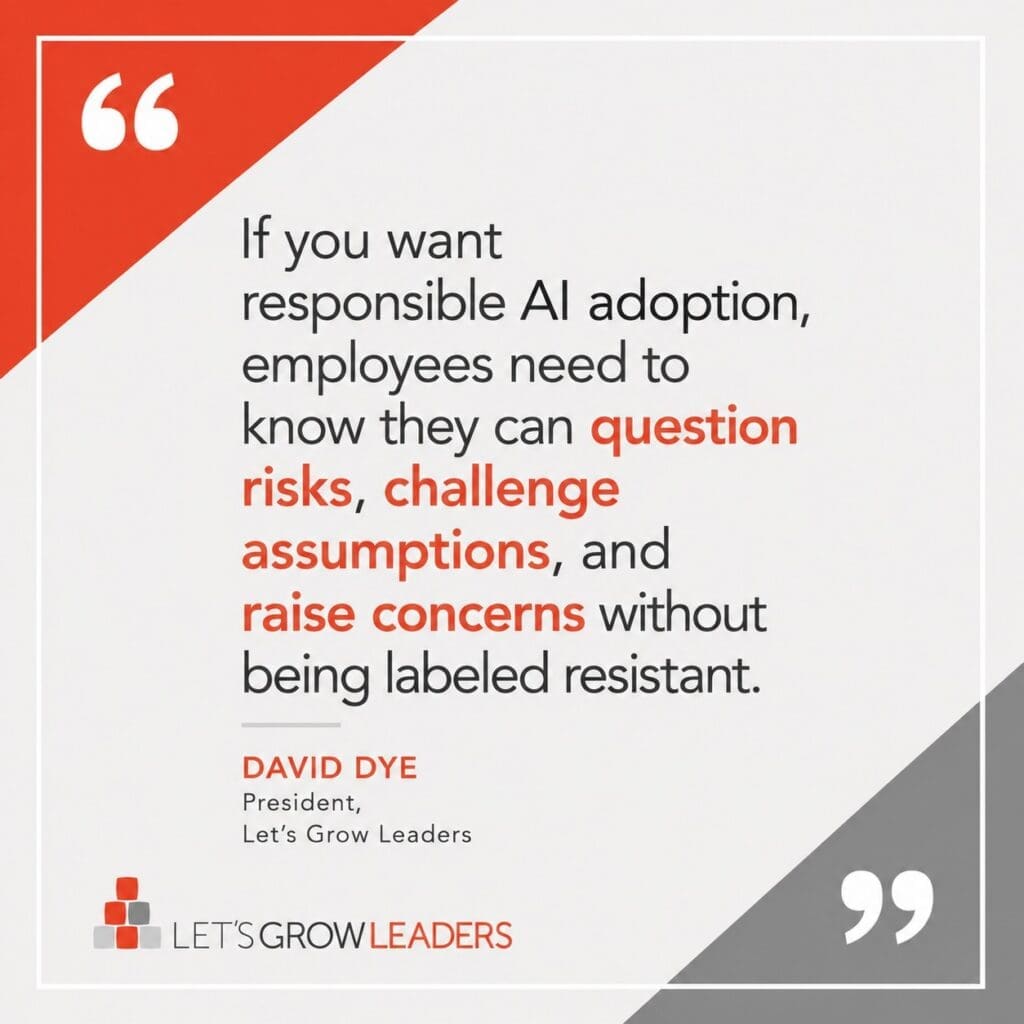
If someone questions accuracy, bias, ethics, or customer risk, do they get labeled resistant? Or do leaders treat those concerns as valuable input?
In our Courageous Cultures research, one of the biggest reasons employees stop speaking up is the belief that leadership either doesn’t want honest feedback or won’t respond constructively.
AI transformation increases that risk because people worry about appearing negative, outdated, or difficult.
You need employees willing to say:
- “I’m not sure this output is accurate.”
- “This could create customer risk.”
- “We need stronger safeguards here.”
- “I think we’re moving too quickly.”
Those conversations protect your business.
5. Practice the Principle
One of the biggest mistakes leaders make during AI transformation is copying someone else’s “best practice” without understanding the principle behind why it works.
One team announces impressive productivity gains with AI, and suddenly every executive team wants to replicate the tactic. But what works in one department, function, or culture may create problems somewhere else.
That’s why courageous leaders focus on principles before practices.
For example, one division of your multinational company may require AI-generated first drafts for every client proposal. Before adopting the same approach, step back and ask:
- What principle are they trying to achieve?
- Faster response times?
- Better consistency?
- Reduced administrative work?
- More time for strategic thinking?
Once you understand the principle, your team can apply it in ways that make sense for your customers, culture, workflows, and risk environment.
This also helps your people think more critically about AI instead of treating every new tool or trend as a mandate.
You want employees asking:
- “What problem are we trying to solve?”
- “What principle should guide this decision?”
- “Where does human judgment matter most?”
- “How do we improve quality, not just speed?”
The organizations that are best at navigating AI change are not blindly chasing every new capability. They are building teams that can think critically about how technology supports their values, customers, and business goals.
6. Galvanize the Genius

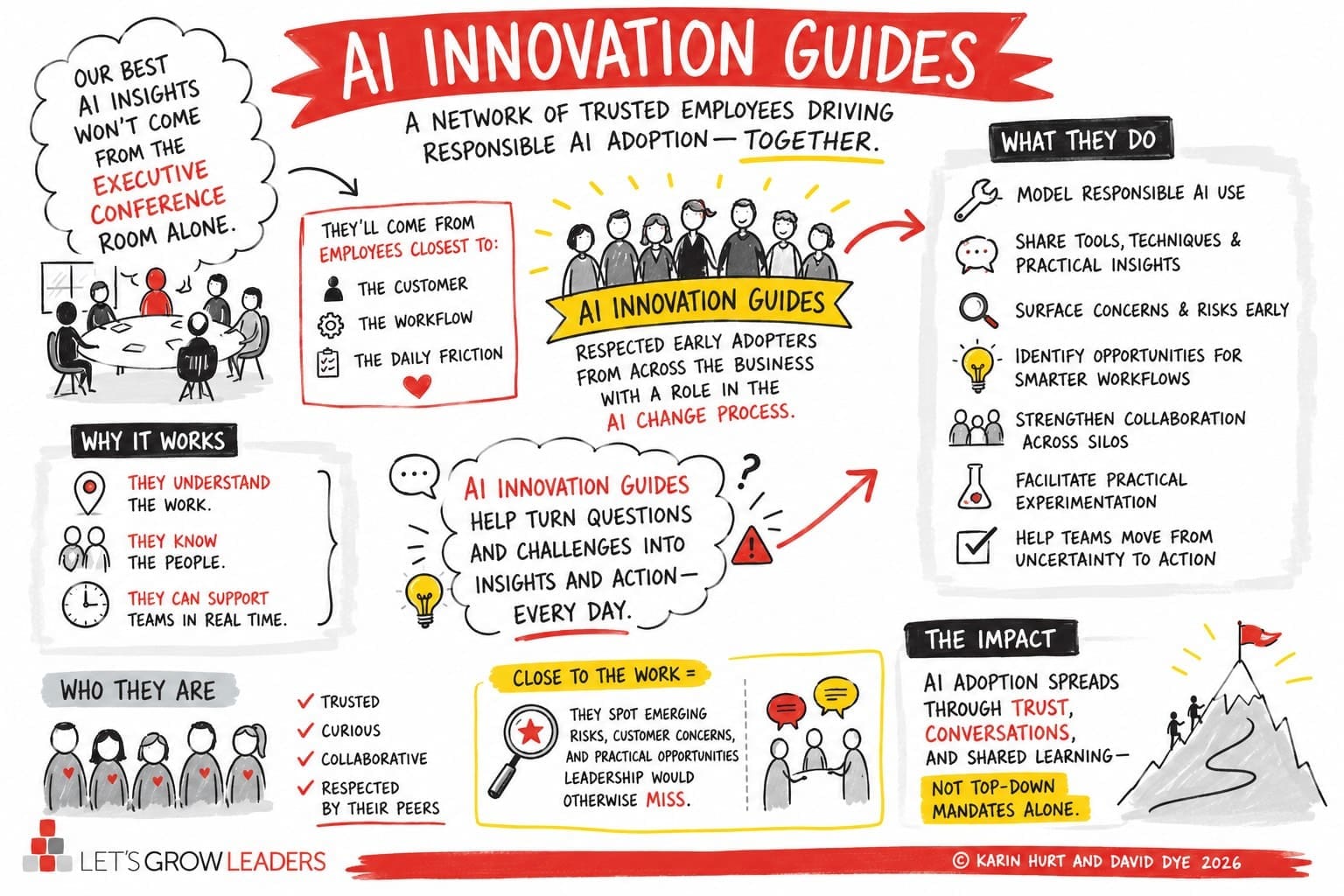
Your best AI insights are unlikely to come from the executives or IT alone.
They’ll come from employees closest to the customer, the workflow, and the daily friction.
When we work with organizations leading large scale change, we recommend bringing together a group of well-respected, early adopters to help design, influence, and reinforce the change
When leading AI change, think about this group as AI Innovation Guides — respected early adopters from across the business who play an active role in the AI change management process.
These employees help bridge the gap between strategy and day-to-day execution.
Because they’re already trusted by their peers and embedded in the work, they can help:
- model responsible AI use,
- share practical tools and techniques,
- surface concerns and risks early,
- identify opportunities for smarter workflows,
- strengthen collaboration across silos,
- facilitate practical experimentation,
- and help teams move from uncertainty into confident action.
Your AI Innovation Guides do not need to be technical experts.
What matters most is that they are curious, credible, collaborative, and eager to help others learn.
They understand the work. Know the people. And can support teams in real time as challenges and opportunities emerge.
This approach also helps AI adoption spread through trust, relationships, and shared learning.
7. Build an Infrastructure for Courage
AI adoption cannot depend on informal experimentation or occasional training sessions alone.
Your people need systems that support responsible innovation over time.
In chapter 12 of Courageous Cultures, we talk about the importance of building an infrastructure for courage—systems, processes, and routines that consistently reinforce contribution, problem-solving, and speaking up.
That becomes even more important during AI transformation because the technology, risks, and expectations are evolving so quickly.
Your infrastructure might include:
- practical AI training
- decision-making frameworks
- governance and escalation paths
- pilot programs
- ethical review processes
- manager coaching
- peer learning groups
- and regular opportunities to share lessons learned
This is also where Challenge and Support Groups can become incredibly valuable.
These are cross-functional mentoring circles led by senior leaders that create space for employees to discuss:
- what’s working,
- where they’re struggling,
- what risks are emerging,
- and how different teams are approaching similar challenges.
These conversations help people build confidence and judgment together, rather than feeling isolated while trying to figure things out on their own.
Strong infrastructure also prevents another common AI leadership mistake: assuming silence means everything is fine.
When employees have clear ways to raise concerns, test ideas, and learn together, leaders gain much earlier visibility into both opportunities and risks.
That kind of learning culture becomes a significant competitive advantage during periods of rapid change.
The Real Leadership Challenge
AI will continue changing how work gets done.
The bigger question is how your culture responds.
Your employees are learning right now:
- whether thoughtful questions are welcome,
- whether judgment still matters,
- whether experimentation is safe,
- and whether leaders value people as much as productivity.
That’s why courageous leadership matters so much in this moment.
Because the organizations that thrive with AI will not simply be the fastest adopters.
They’ll be the organizations that build the most trust, learning, discernment, and innovation alongside it.
Are you looking for practical, human-centered approaches to lead your team through uncertainty and change? That’s what we do best. We’d love to set up time to learn more about your goals and challenges


0 Comments