
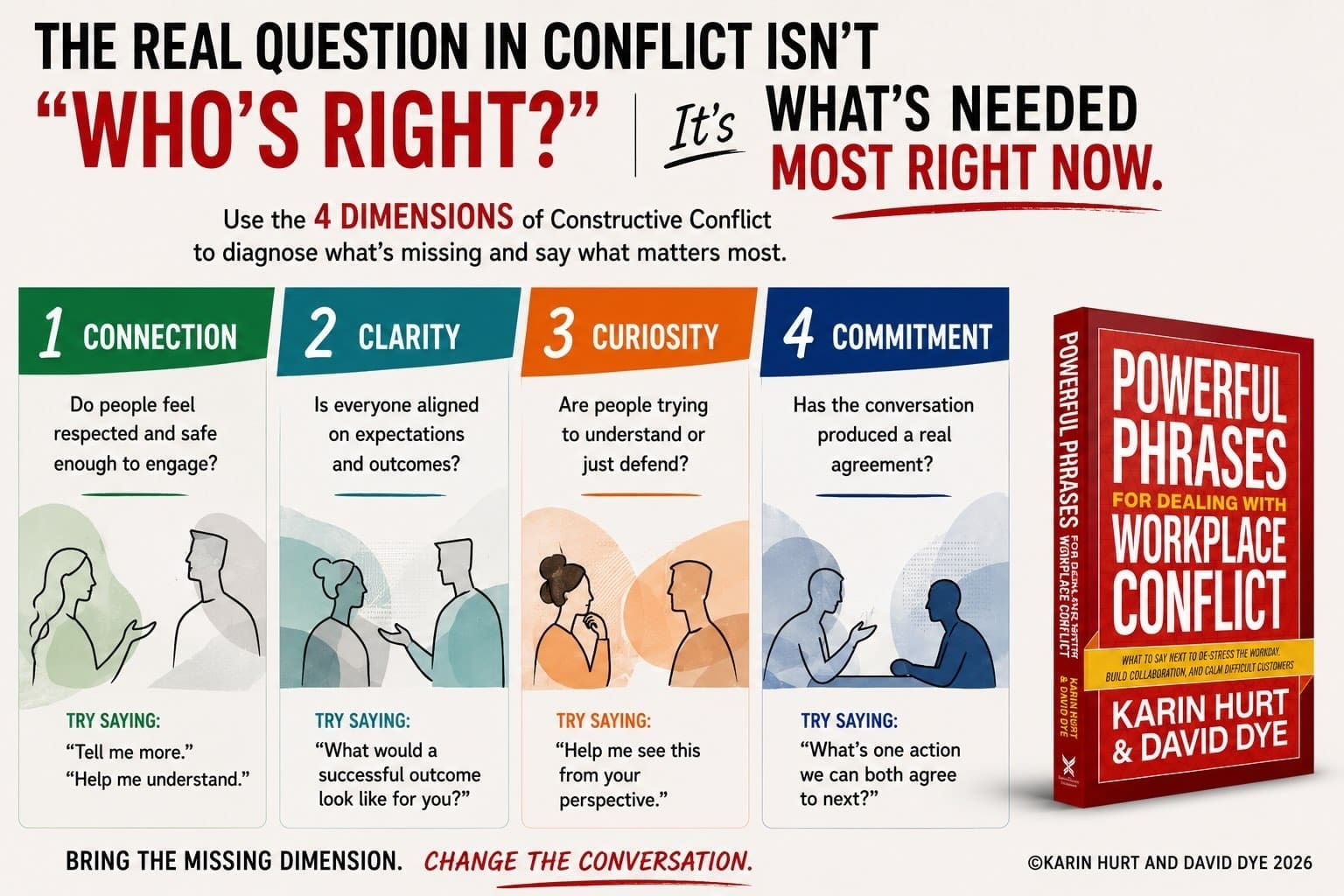
It’s “What’s Needed Most Right Now?”
Most workplace conflict feels urgent.
You want to explain yourself. Defend your idea. Correct the misunderstanding. Fix the problem. End the tension.
But the moment you rush to solve the conflict before understanding what the conflict truly needs, things usually get harder.
Because not every conflict needs the same thing first.
Sometimes the problem isn’t the disagreement itself. It’s the lack of trust underneath it.
Sometimes you don’t need a better argument. You need clearer expectations.
Sometimes the conversation is stuck because nobody feels heard.
And sometimes everyone has talked long enough, and it’s finally time to decide what happens next.
When you can recognize which dimension is missing, you stop spinning in circles and start making progress.
Instead of asking:
“How do I win this conversation?”
You start asking:
“What’s needed most right now?”
That question changes everything.
The 4 Dimensions Give You a Way to Diagnose Conflict Fast
Most people enter conflict trying to find the perfect response.
But the better question is:
“What does this conversation need most right now?”
That’s where the four dimensions of collaboration become incredibly practical.
Instead of reacting emotionally or trying to “win,” you can quickly identify what’s missing:
- Connection — Do people feel respected and safe enough to engage?
- Clarity — Is everyone aligned on expectations and outcomes?
- Curiosity — Are people trying to understand or just defend?
- Commitment — Has the conversation produced a real agreement?
When you can spot the missing dimension, you stop escalating the wrong thing.
A conflict that needs connection won’t improve with more pressure.
And, a conflict that needs clarity won’t improve with more emotion.
A conflict that needs commitment won’t improve with another hour of discussion.
That’s the framework behind this short video:
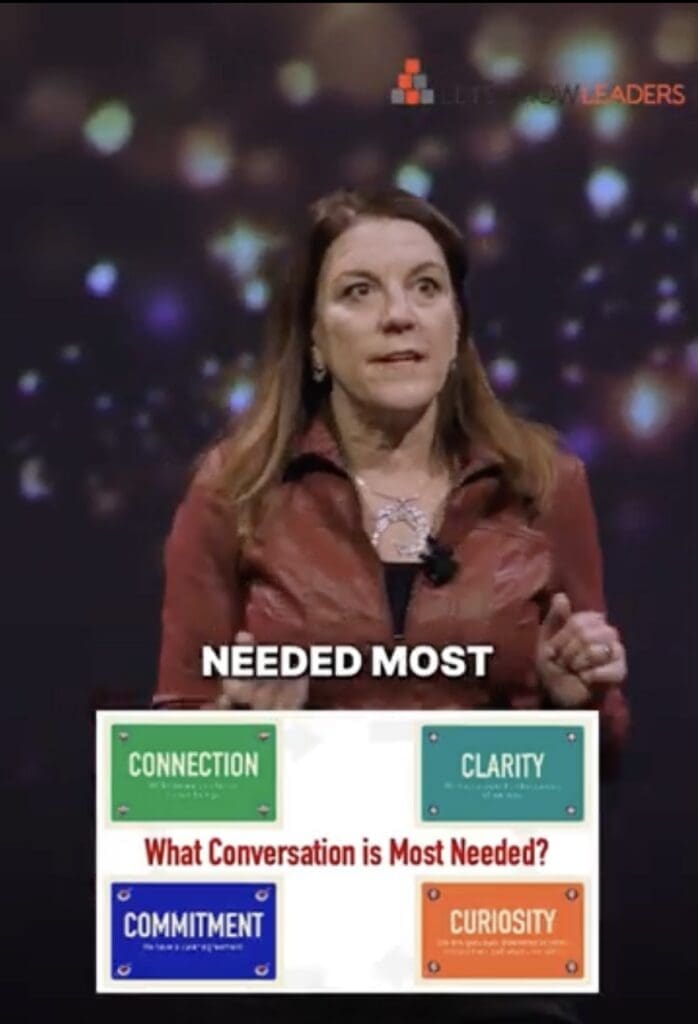
Watch this quick video to learn more
Watch for the moment where you recognize your own default pattern. Most of us naturally overuse one dimension and underuse another.
You might:
- jump to commitment before people feel heard,
- over-focus on connection while avoiding hard clarity,
- or stay endlessly curious without ever deciding anything.
The breakthrough is learning to recognize what the conflict actually needs next.
1. When Connection Is Missing, Everything Feels Harder
You can’t solve a problem with someone who feels unseen, dismissed, or unsafe.
And yet this is where many conversations go sideways immediately.
You jump straight into facts, logic, timelines, or performance issues while the other person is still silently wondering:
- Do you respect me?
- Are you against me?
- Is this conversation going to embarrass me?
- Do you actually care what I think?
When connection is missing, even perfectly reasonable words can sound threatening.
You’ve probably experienced this yourself. Someone says something technically fine, but their tone, timing, or history with you makes it land badly.
Connection changes how people hear you.
That’s why one of the most powerful phrases in conflict is incredibly simple:
“Tell me more.”
Not because it magically fixes everything.
Because it signals something deeper:
“I’m here to understand you, not overpower you.”
Sometimes the fastest way through conflict is slowing down long enough to make another human being feel like a human being again.
2. When Clarity Is Missing, Frustration Takes Over
A surprising amount of conflict is confusion wearing emotional clothing.
You thought the deadline was obvious. They thought priorities had changed.
You assumed ownership was clear. They assumed someone else had it.
You expected initiative. They expected direction.
And now everyone’s frustrated.
One of the biggest reasons conflict drags on is that people argue about behavior before defining what a successful outcome will do.
You hear it all the time:
“This isn’t working.”
Okay… what would work?
If nobody can answer that question clearly, the conversation stalls.
Clarity creates movement.
That’s why one of the best conflict questions is:
“What would a successful outcome do for you?”
Not:
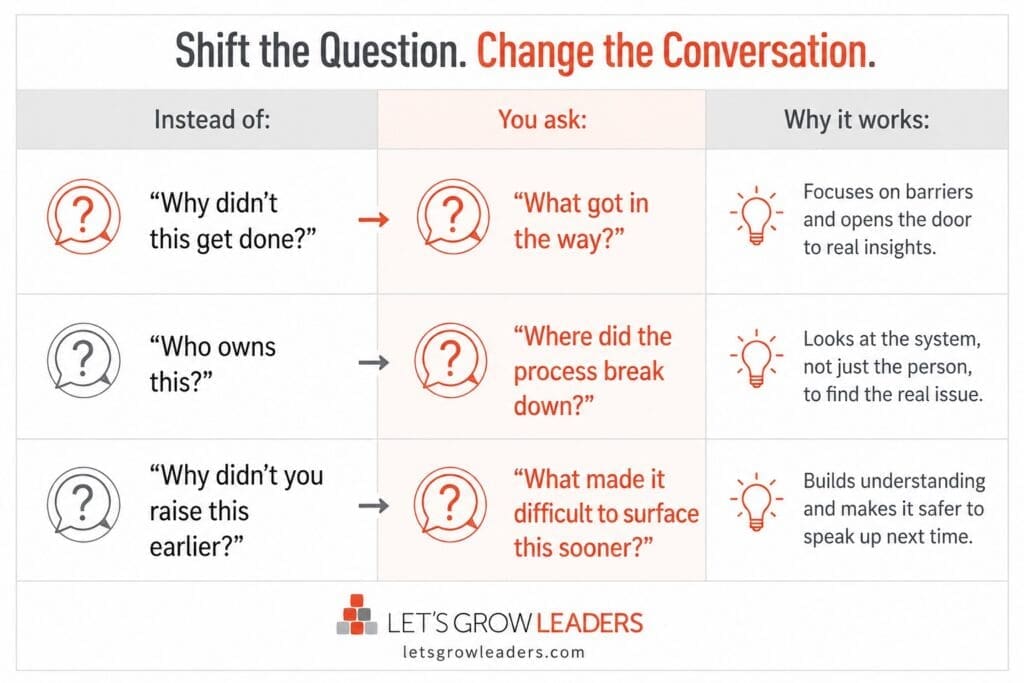
- “Why are you doing this?”
- “Why can’t you just…?”
- “What’s your problem?”
The moment you create a shared understanding of what “better” looks like, conflict becomes far easier to navigate.
3. When Curiosity Disappears, Defensiveness Takes Over
This is the hardest dimension for most people.
Because when you feel frustrated, hurt, or disrespected, curiosity is usually the first thing to disappear.
You stop trying to understand and start trying to prove.
But curiosity is what unlocks stuck conversations.
The kind that says:
“I may not agree with you, but I genuinely want to understand how this looks from your perspective.”
Why?
Because most people escalate when they feel cornered.
Curiosity creates breathing room.
And here’s the hidden bonus: curiosity also regulates you. It’s impossible to be furious and curious at the same time.
The best conflict navigators aren’t necessarily calmer people. They’re often just more curious people.
4. When There’s No Commitment, Conflict Repeats Itself
This is where good conversations often fail.
People connect, clarify, and explore perspectives.
And then…
Nothing changes.
No decisions, ownership, or next steps. Without commitment, conflict becomes emotional recycling.
You revisit the same conversation again and again because nobody translated insight into action.
That’s why productive conflict eventually needs questions like:
“What’s one action we can both agree to next?”
Or:
“Let’s recap what we’re each committing to.”
Healthy conflict requires operational resolution.
Otherwise the tension quietly returns next Tuesday at 2:17 p.m. in another meeting.
The Most Important Skill Is Knowing Which Dimension Is Missing
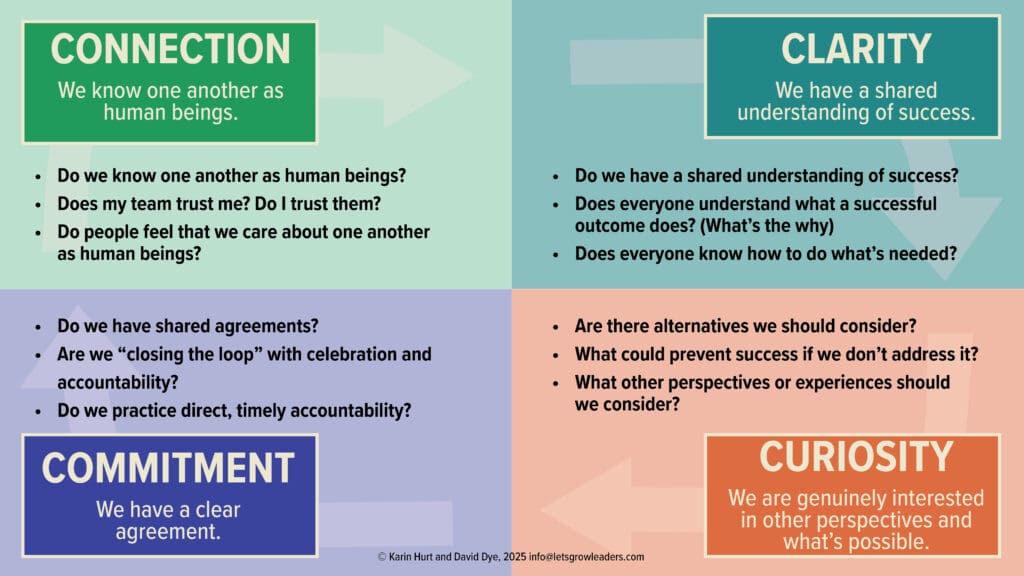
In the middle of conflict, you need the ability to diagnose what the conversation needs most.
Ask yourself:
- Is this a connection problem?
- A clarity problem?
- A curiosity problem?
- Or a commitment problem?
Because when you bring the missing dimension into the conversation, people often soften surprisingly fast.
And that changes the trajectory of the conversation.
Conflict becomes less about winning and more about understanding what will move things forward.
That’s the work. That’s human-centered influence.
Inspired by Chapter 3, “The Four Dimensions of Constructive Conflict,” from Powerful Phrases for Dealing with Workplace Conflict by Karin Hurt and David Dye.



0 Comments