

Your leadership presence directly affects your team’s focus and energy.
Sandra looked up with a frown after the CEO left the skip-level meeting where the team was celebrating an innovation project. She shook her head as she stared out the door he’d just left. “He barely looked up from his phone.” The team sighed. They had so much energy when they arrived, but the CEO’s leadership presence, or lack of it, wiped out all their enthusiasm.
Unfortunately, this is a pattern we’ve seen from leaders at every level.
You can feel it when a team is fully present. People look up. They listen longer. They build on what was just said instead of repeating the point they were waiting to make. The conversation moves faster because no one has to keep mentally pulling the team back into the room.
You can also feel the opposite: someone half-listens while answering a message. In a virtual meeting, another person has three tabs open and is quietly finishing “one quick thing.” You ask for input and get the polite pause that means everyone needs a moment to reconstruct what just happened.
As a leader, your presence sets the tone.
In a world where phubbing and distraction are an epidemic, when you show up focused, you signal that this conversation matters, this work matters, and the people in this room matter.
That’s the heart of the SynergyStack® Connection habit: Be Present. I show up strong, focused on our team and the work we are doing.
The sample phrase is simple: “I’ve turned off my phone. Let’s do this!”
Whether you have a formal leadership role or want more influence, developing your leadership presence is simple. Practical. And surprisingly powerful.
What Presence Looks Like
You give your attention before you ask for engagement.
It looks like closing the laptop when the conversation requires listening. It sounds like, “I want to give this my full attention. Give me ten seconds to finish this note, and then I’m with you.”
It also means you notice when your attention has drifted and bring it back.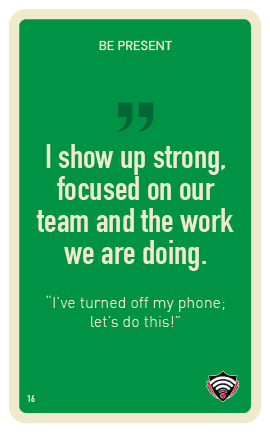
Being present is a connection habit because attention is one of the clearest ways you communicate respect. Your team may not remember every word you say in a meeting. They will remember whether you were genuinely there.
Why Leadership Presence Changes the Quality of the Conversation
Most teams don’t lose connection all at once. It leaks away through small signals.
A phone on the table. A leader glancing at email while someone shares a concern. A meeting where people speak in fragments because they’re mentally juggling the next meeting, the unfinished project, and the message that just lit up their screen.
None of these moments are intended as disrespect. They’re often the result of real pressure. You have a full calendar. Your team has competing priorities. The pace of work keeps pushing everyone toward partial attention.
But partial attention has a cost.
People stop offering their best thinking when they sense no one’s listening. They hold back the concern, the new idea, or the more honest answer. They may still attend the meeting, but they contribute less of themselves.
Presence creates the opposite effect.
When you listen closely, ask a connected follow-up question, and stay with the conversation, you make it easier for others to do the same. You slow the noise long enough for people to think. You reduce rework because the team catches detail the first time. You build trust because people experience your attention as evidence that their voice matters.
Connection is built through repeated signals that say, “You matter here. Your contribution matters. This work matters.”
How to Practice Being Present Without Overcomplicating It
To build your leadership presence, start with visible cues.
Put your phone away. Close the unrelated tabs. Turn your body toward the conversation. Make eye contact when someone is speaking. Take notes that are relevant to the discussion rather than using the meeting as cover for other work.
These small moves help your team know what to expect from you. They also help your own brain settle into the moment.
Then name your intention.
Try: “I’m closing everything else so I can focus on this.”
Or: “I want to make sure I understand before we move to solutions.”
You don’t need a speech. A short signal like “I’ve turned off my phone. Let’s do this!” is enough.
And, when you can’t be fully present, be honest.
There will be moments when you are pulled in too many directions. In those cases, don’t fake attention. Say, “I want to give this the focus it deserves, and I’m not there yet. Can we take five minutes so I can wrap this up and come back ready?”
That kind of transparency builds more trust than pretending to listen while your attention is somewhere else.
Presence Is Especially Important When the Stakes Are High
Your leadership presence becomes even more critical during conflict, change, uncertainty, or problem solving.
When people are frustrated, they watch your attention carefully. When a team is confused, they need your focus to help create clarity. When someone brings you a hard truth, your presence tells them whether it was safe to speak up.
A distracted leader can accidentally escalate tension. A present leader helps the room breathe.
Presence doesn’t mean you have every answer. It means you are available to the conversation in front of you. You listen for what is said, what is underneath it, and what the team needs next.
That’s often where the leadership work begins.
Three Mini-Experiments to Build a Habit of Presence
If you want Be Present to become more than a good intention, turn it into a mini-experiment. Choose one small behavior you can practice consistently for two weeks.
1. The Ten-Second Reset
Before you enter a meeting, pause for ten seconds.
Ask yourself: “What does this team need from me right now?”
Then enter the conversation with that intention.
This mini-experiment is especially useful when you’re coming from a difficult meeting, a rushed deadline, or a distracting conversation. Your team shouldn’t have to inherit the emotional leftovers from the last thing on your calendar.
2. Presence Cue Practice
For the next two weeks, begin every team meeting or one-on-one by putting your phone away and saying one sentence that signals your attention.
Try: “I’ve turned off my phone. Let’s do this.”
Notice what changes when your team sees you remove the distraction instead of simply hoping they’ll trust your focus.
3. The One Follow-Up Question
In every meaningful conversation for the next two weeks, ask one follow-up question before you respond with your own idea.
Try:
“What’s most important about that?”
“What have you already tried?”
“What would a good outcome look like from your perspective?”
“What am I missing?”
This practice helps you stay present long enough to understand. It also shows your team that you value their thinking, not just their update.
Make Presence a Team Habit
Once you’ve practiced Be Present yourself, invite the team into the habit. “What is one action we can take to help us stay focused when we’re together?”
Maybe phones stay off the table during problem-solving conversations. Maybe meetings begin with a clear purpose and end when the purpose is complete. Maybe anyone can say, “Can we reset?” when the group drifts.
The goal is a team environment where presence becomes easier because everyone knows what it looks like.
Being present isn’t flashy. It doesn’t show up in a spreadsheet or project plan. But it changes the room.
You show up strong. You focus on the team and the work you’re doing together. And in a world full of distractions, that kind of attention becomes a leadership advantage.
And if you want to help your team develop these habits of collaboration to work better together and get more done with less stress, check out the full SynergyStack® System. In less than 60 minutes you can transform everyone’s focus and productivity.





0 Comments