

Stop Fighting Resistance to Change. Get Curious About It.
You’ve been working hard with your colleagues on a new initiative—one you genuinely believe will make things better.
The strategy is sound. The data backs it up. You’re ready to move.
But when you present it to your team, instead of momentum, you’re met with blank stares, crossed arms, or polite nods followed by silence.
You explain the benefits again. You add more evidence. You turn up the enthusiasm.
Nothing.
If you keep pushing, the best you’ll get is barely-there compliance. Your normally energetic team is suddenly showing resistance to change.
How do you overcome resistance to change as a human-centered leader?
How Do You Overcome Resistance to Change?
To reduce resistance to change, don’t push harder. Start by building connection and acknowledging how the change affects people. Create clarity about what is changing, why it matters, and what employees can influence. Stay curious to surface concerns, risks, and ideas early. Then build commitment by translating the change into specific behaviors, ownership, deadlines, and follow-through.
In other words, resistance isn’t something to overpower. It’s information.
Your team may be protecting something they value: their competence, relationships, workload, identity, credibility, or sense of control. Their concerns might reveal a risk you haven’t considered—or a smarter way to implement the change.
When you stop treating resistance as defiance, you can start learning from it.
A Binge-Worthy Approach to Resistance to Change
Think about the last show you binged.
You didn’t press “next episode” because everything had been neatly resolved. You kept watching because you had questions.
The hero made a risky choice. A villain gained ground. A relationship suddenly became uncertain.
You had to know: What happens next?
That’s not just superb storytelling. “What happens next?” is also a powerful leadership question.
Helping your team embrace a new idea isn’t about showing up with every answer. In fact, if you lead with nothing but your ideas, you may create even more resistance.
Instead, create the conditions that help people lean in, wrestle with the challenge, and contribute to what happens next.
You can do that through four dimensions of meaningful collaboration: Connection, Clarity, Curiosity, and Commitment.
Four Leadership Moves to Transform Resistance Into Momentum
1. Connection: Build Trust Before Asking People to Move
Every compelling story starts with characters you care about. You connect with them before you become invested in what happens to them.
The same is true for your team.
If people don’t feel seen, heard, or respected, no amount of strategy or vision will earn genuine commitment.
And even positive change can create loss.
A new system can make someone feel like a beginner again. A reorganization can disrupt valued relationships. A new strategy may make months of hard work feel irrelevant. An exciting opportunity for the organization might create more work or uncertainty for the people implementing it.
Acknowledge that reality.
Try:
“I know this change will affect how you work, and I want to understand what concerns you most.”
Or:
“Before we talk about implementation, what feels most important for us to acknowledge?”
Connection does not mean forcing people to share personal information or turning every meeting into group therapy. It means showing up as a human being and treating your employees like human beings.
And connection doesn’t happen only before the change. Continue checking in as people encounter new challenges, frustrations, and questions.
Trust gives you the foundation to create a little tension—the productive kind.
2. Clarity: Make the Stakes—and the Boundaries—Clear
People binge shows because they want to know what happens next.
One of your most powerful leadership moves is to create that same tension by helping people understand what’s at stake—without rushing to resolve everything for them.
Instead of walking into the room and dropping your finished plan on the team, begin with the story behind it.
Be clear about:
- The problem or opportunity you’re addressing.
- Why it matters now.
- What could happen if nothing changes.
- What a successful outcome would make possible.
- What is changing and what is not changing.
- What has already been decided.
- What your team can still influence.
That last distinction is critical.
If a change is not optional, don’t manufacture the illusion of choice. Asking people whether they want a decision that has already been made will only damage trust.
Instead, say:
“The decision to make this change has been made. What we have the opportunity to shape is how we implement it well.”
Or:
“Here’s what has been decided. Here’s what is still open for your input. And here’s where I’d particularly value your expertise.”
Once people understand the stakes and the boundaries, pause.
Let them sit with the gap between where you are and where you need to go. Give them space to feel the problem, question assumptions, and consider possibilities.
Your job isn’t to spoon-feed every solution. It’s to create a shared understanding of the challenge so people want to help resolve it.
3. Curiosity: Surface the Real Source of Resistance
Once people understand what’s at stake, shift to curiosity.
This is where your team begins to imagine, question, challenge, and co-create. And your best leadership move may not be another presentation. It might be a genuine pause.
Even if everyone immediately turns to you for the answer, stay curious a little longer.
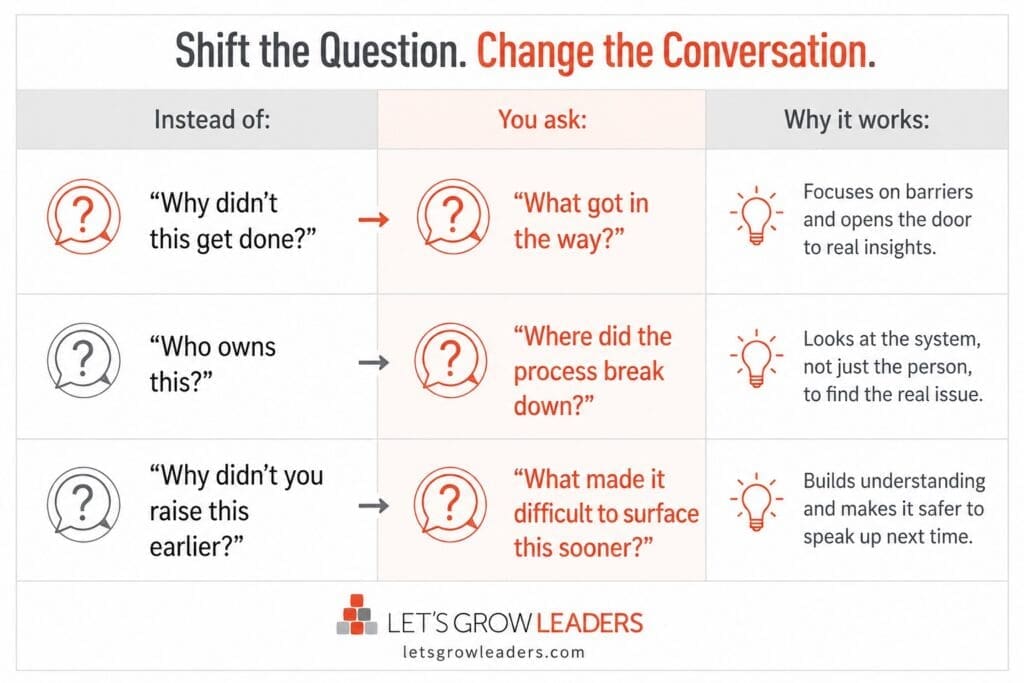
Ask:
- “What concerns you most about this change?”
- “What are you afraid we might lose?”
- “What do you see that we may be missing?”
- “What could prevent this from working?”
- “What would make implementation easier?”
- “Whose perspective have we not considered?”
- “What do you suggest we do next?”
These cannot be rhetorical questions asked while you wait for people to arrive at your preferred answer.
If you ask for concerns and then become defensive, explain each one away, or punish the person who raised them, your team will learn quickly: leadership didn’t really want to know.
Respond with regard—even when you disagree.
You might say:
“That’s an important concern. Tell me more about what you’re seeing.”
Or:
“I hadn’t considered that implication. What would you recommend?”
Sometimes your team will arrive at the solution you were considering. Sometimes they’ll improve it. And sometimes their concerns will reveal a risk that genuinely changes your approach.
If they don’t reach a workable solution, add your idea to the conversation:
“I have an approach I’d like us to consider. What would make this stronger?”
You’re still leading. You’re simply making room for the expertise around you.
4. Commitment: Turn the Conversation Into Action
Every binge-worthy story eventually resolves—at least for the moment.
Your team needs that, too.
Curiosity without commitment becomes an interesting conversation that changes nothing. Once you’ve surfaced concerns and explored possibilities, turn the discussion into specific action.
Ask:
- “What are our next steps?”
- “Who owns each action?”
- “What does success look like?”
- “What will we need to stop doing?”
- “What support or resources do you need?”
- “When will we check progress and adjust?”
- “How will we hold ourselves accountable and celebrate progress?”
Be explicit. No vague agreements. No “we’ll circle back.” No ending the meeting with five people believing five different things.
Try:
“To recap, we’ve agreed that Maya will complete the pilot by September 15. Jordan will gather customer feedback, and we’ll meet on September 20 to review what we’ve learned and decide what happens next.”
Also clarify the practical behaviors the change requires.
“Embrace the new system” isn’t a behavior.
“Use the new system for every customer request beginning Monday, flag errors in the shared channel, and bring recurring issues to our Friday check-in” is much clearer.
Specific commitments reduce anxiety because people know what to do, who is responsible, and when they’ll have an opportunity to revisit the plan.
And that follow-up conversation? Think of it as the beginning of the next episode, not an afterthought.
You’re Not the Hero—Your Team Is
You may think your job is to be the visionary, the fixer, or the person with the bold answer.
But leading change is more like being a great showrunner.
You establish the structure. You clarify the stakes. You create space for productive tension. And then you help the cast—your team—do their best work.
You don’t need to have every answer. You need to help people understand the story, contribute their expertise, and co-create what happens next.
In a workplace filled with burnout, competing priorities, and change fatigue, your team doesn’t need another enthusiastic mandate.
They need leadership that creates connection, offers honest clarity, stays genuinely curious, and builds commitment through shared ownership.
So, the next time you need your team to embrace a new idea, don’t just pitch the solution.
Help them become invested in what happens next.
Frequently Asked Questions About Resistance to Change
Why do employees resist change?
Employees may resist change because they don’t understand why it is necessary, don’t trust the people leading it, fear losing something they value, feel overwhelmed by constant change, or see practical risks leaders have missed. Resistance is often useful information about gaps in connection, clarity, capability, capacity, or commitment.
How can leaders reduce resistance to change?
Leaders can reduce resistance by acknowledging how the change affects people, explaining why it matters, clarifying what is decided and what employees can influence, inviting honest concerns and ideas, and translating the change into specific behaviors and next steps. Consistent follow-through matters as much as the initial announcement.
What if the change is not optional?
Be honest that the decision has been made. Don’t ask employees to vote on something they cannot change. Instead, explain the rationale, acknowledge the impact, and clarify where they still have meaningful influence. Employees may not control whether the change happens, but they can often help determine how it is implemented.
How should a leader respond to a highly resistant employee?
Start with curiosity rather than judgment. Meet privately and ask what specifically concerns them, what they believe is at risk, and what would help them move forward. Listen for a clarity, capacity, capability, or commitment problem. Then address the actual issue while remaining clear about expectations and required behaviors.
How do you address change fatigue?
Acknowledge the cumulative impact of repeated change. Clarify what matters most now, retire or pause lower-priority work, and avoid adding new expectations without discussing capacity. Give people opportunities to influence implementation, recognize progress, and create predictable check-ins so the change doesn’t feel like an endless series of surprises.
What is the biggest mistake leaders make when addressing resistance to change?
The biggest mistake is treating resistance as a problem to defeat. Pushing harder, overselling the benefits, or labeling employees as negative often creates more resistance. Effective leaders get curious about what the resistance reveals and then respond with greater connection, clarity, curiosity, and commitment.
Help Your Leaders Navigate Change With Greater Confidence
If your organization is navigating AI adoption, reorganization, culture change, or rapidly shifting priorities, we can help.
Let’s Grow Leaders offers highly interactive leadership keynotes and customized leadership development programs that give leaders practical tools to build trust, surface concerns, create clarity, and turn change into meaningful action.





0 Comments