
Before You Decide They Don’t Care, Get Curious
Someone on your team isn’t performing the way you need them to.
You’ve reminded them about the deadline. Explained why the work matters. Maybe you’ve offered more support, checked in more frequently, or quietly completed part of the work yourself to keep things moving.
And now you’re frustrated.
You care about this person and want them to succeed. You also care about the rest of the team—the people compensating for missed commitments, correcting mistakes, or wondering why you haven’t addressed what everyone can see.
And, you don’t want to make an unfair assumption. You also can’t let the poor performance continue.
When performance slips, your mind naturally starts creating explanations:
They don’t care. Aren’t capable. Have a bad attitude…
One of those explanations MIGHT be true. But poor performance is a symptom. Your first interpretation isn’t always the right diagnosis.
Human-centered performance management starts with enough curiosity to understand what’s really happening—and enough courage to respond appropriately once you do.
How to Diagnose Poor Performance: A Quick Answer
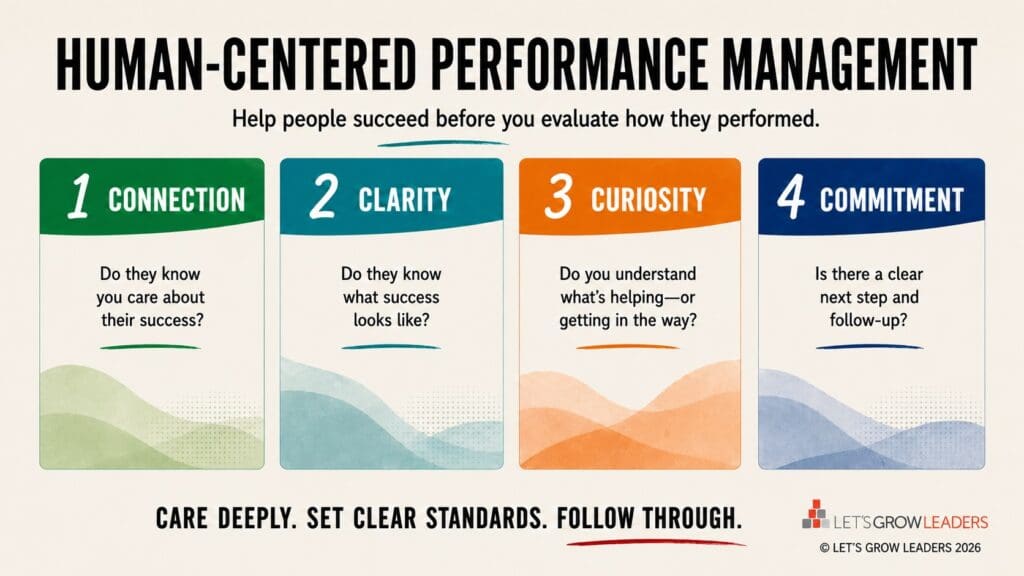
Use the four dimensions of the Performance Loop to ask four diagnostic questions:
- Connection: Do they feel supported and understand why their work matters?
- Clarity: Do they know the Most Important Thing and what success looks like?
- Curiosity: What’s helping or hindering their performance—including capability, confidence, capacity, and context?
- Commitment: Do they understand the expectation and consistently follow through?
The right response depends on what you discover. Reconnect when trust or purpose is missing. Clarify expectations. Stay curious about skills, confidence, workload, and systems. Then establish a specific commitment and follow up.
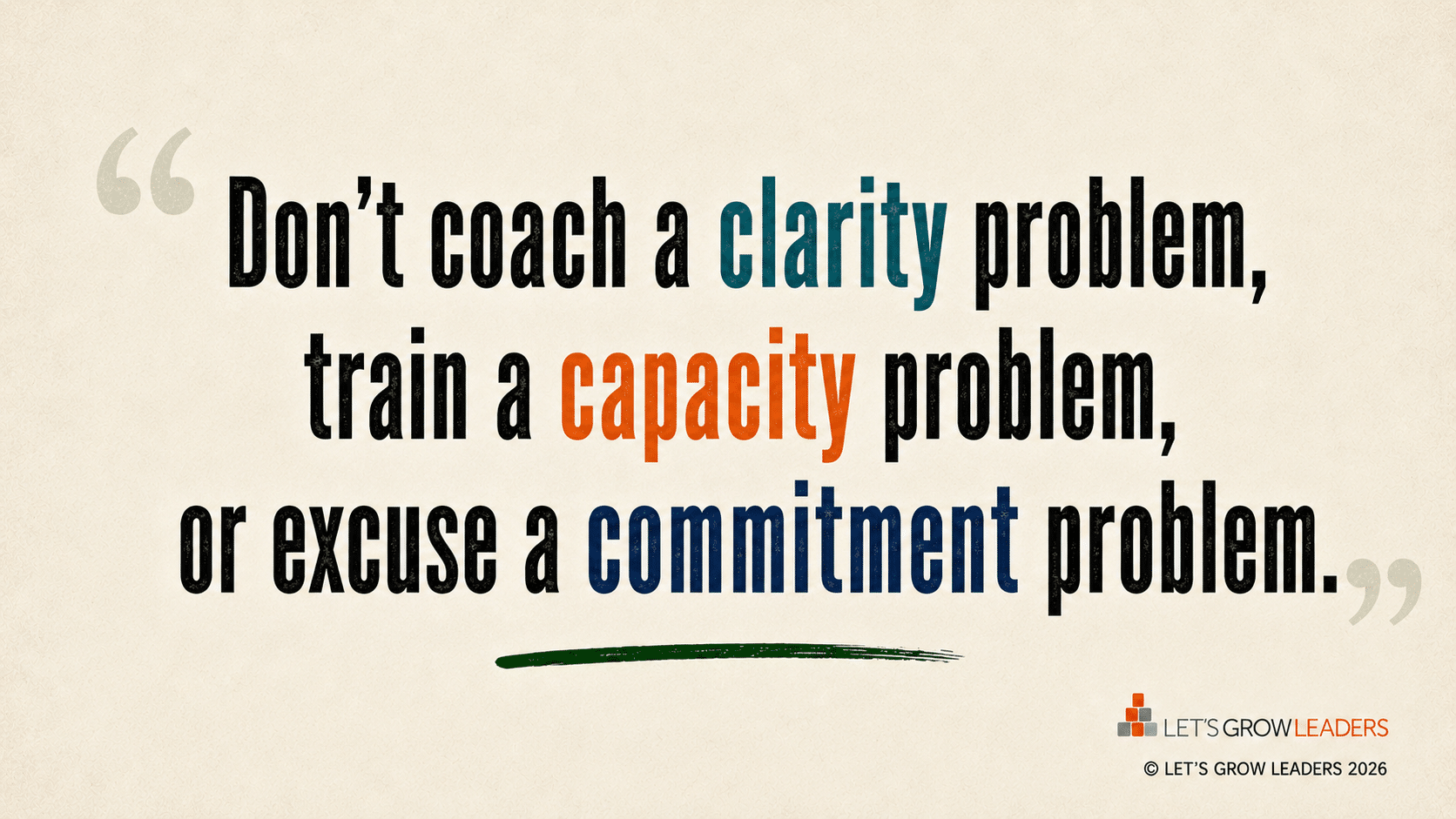
Don’t coach a clarity problem, train a capacity problem, or excuse a commitment problem.
Start With What You Observe
Before diagnosing the problem, separate what you’ve observed from what you’ve concluded.
“Jordan has a bad attitude” is a conclusion.
“Jordan interrupted three colleagues and dismissed their suggestions before they finished explaining them” describes observable behavior.
You can address observable behavior. Stay curious about what it means.
Try:
“I noticed that the last three weekly reports arrived after the Tuesday deadline. I’d like to understand what’s happening and talk about what you need to get them in on time.”
Now you have something specific to discuss.
Use the Performance Loop to Diagnose Poor Performance
Our Performance Loop balances results and relationships through four dimensions: Connection, Clarity, Curiosity, and Commitment.
These dimensions can also help you understand poor performance before you prescribe the wrong solution.
1. Connection: Do They Feel Supported and Understand Why the Work Matters?
Performance can slip when people feel disconnected—from their manager, the team, the customer, or the purpose behind the work.
They might not understand why a task matters. Perhaps they’ve stopped raising concerns because previous attempts were dismissed. Or they may be struggling after a reorganization, leadership change, or shift in how the team works.
Ask yourself:
- Do they understand who is affected by their work?
- Have I recognized what they’re doing well?
- Do they feel safe raising concerns early?
- Has something changed in our working relationship?
Start with positive intent:
“I care about your success. I’ve noticed a change in your follow-through, and I’d like to understand what’s happening.”
Connection doesn’t replace accountability. It creates the trust that makes an honest accountability conversation possible.
2. Clarity: Do They Know the MIT (Most Important Thing) and What Success Looks Like?
Many performance problems begin with an expectation that felt clear to the manager but never became clear to the employee.
You said, “Keep me informed.”
They thought that meant sending a weekly update. You expected to hear about a customer escalation immediately.
Before holding someone accountable, ask:
- Have I made the Most Important Thing unmistakably clear?
- Did we agree on the outcome, quality, timing, and priority?
- Does the employee know how success will be measured?
- Did I check for understanding?
Telling someone what to do isn’t the same as creating shared clarity.
Try:
“I want to make sure I communicated this clearly. What are you hearing as the most important outcome?”
If their answer isn’t what you intended, reset the expectation.
“I realize I wasn’t as specific as I needed to be. That’s on me. Let’s clarify what success looks like going forward.”
Taking responsibility for unclear expectations doesn’t weaken your authority. It gives you both a fair foundation for future accountability.
3. Curiosity: What’s Helping or Hindering Their Performance?
Once the expectation is clear, stay curious about what’s getting in the way.
Managers often jump too quickly to a solution. They send someone to training, increase oversight, or deliver a stern reminder before understanding the problem.
Instead, explore four possibilities.
Capability: Do They Know How?
The employee may understand the expectation but lack the skill or experience to meet it.
Ask:
“Which parts of this process feel familiar, and where would more training or practice help?”
If capability is the issue, teach. Provide examples, practice, feedback, and a reasonable timeframe for improvement.
Confidence: Do They Believe They Can?
An employee can know exactly what to do and still hesitate.
Low confidence can look like disengagement: overchecking decisions, avoiding reasonable risks, waiting too long to act, or asking for excessive reassurance.
Our Confidence-Competence Model helps you distinguish what someone can do from how confident they feel doing it.
If competence is high and confidence is low, more instruction can backfire. Instead, offer a specific confidence burst:
“I’ve seen you handle situations like this successfully. What did you do then that could help you now?”
Then give them room to act.
Capacity: Do They Have the Time, Focus, and Resources?
Sometimes the employee is capable, confident, and completely overloaded.
Everything is urgent. Priorities keep shifting. Two leaders believe their work should come first. The employee spends so much time responding to requests that the MIT never gets finished.
Ask:
“Walk me through everything competing for your attention. What tradeoffs do we need to make?”
A capacity conversation shouldn’t end with “Just do your best.” Decide what comes first, what can wait, and what will no longer be done.
If everything remains a priority, you haven’t actually prioritized.
Context: Is the System Making Success Unnecessarily Difficult?
A talented, committed employee can still struggle inside a process that fights them every step of the way.
Perhaps approvals take two weeks, but the work is due in ten days. The employee owns the outcome but lacks decision authority. An upstream team consistently delivers information late.
Ask:
“Where does the process consistently slow down or break?”
“What dependency makes this commitment difficult to keep?”
Context doesn’t eliminate accountability. Employees still need to raise concerns early and adapt where they can.
AND… don’t hold someone accountable for overcoming an organizational obstacle that only you or a more senior leader can remove.
4. Commitment: Do They Understand the Expectation and Follow Through?
Sometimes the employee understands the MIT, has the skills and confidence, and has reasonable capacity and support.
And they still don’t follow through.
That’s a commitment problem.
Human-centered leadership doesn’t mean searching forever for an explanation that makes accountability unnecessary. Once you’ve addressed legitimate barriers, it’s time for a direct conversation.
“We’ve clarified the expectation and addressed what was getting in the way. You committed to completing these follow-ups within two business days, and that hasn’t happened. What’s going on?”
Then invite a specific solution:
“What action are you willing to take going forward?”
Review what you heard and Schedule the Finish:
“So, you’ll update the customer record before closing each case. Let’s review progress in two weeks.”
Move From Diagnosis to the Right Conversation
Once you understand what’s contributing to the poor performance, choose the response that fits.
Reconnect when trust or purpose is missing. Clarify expectations. Teach a skill. Encourage confidence. Reprioritize the workload. Repair a broken process.
And when the employee has what they need but isn’t following through, hold an accountability conversation.
Our INSPIRE Method provides a practical structure for that conversation. If the behavior continues, the ART approach can help you address the Action, name the Repetition, and discuss the broken commitment’s effect on Trust.
Human-Centered Doesn’t Mean Excuse-Centered
Getting curious about poor performance isn’t about lowering expectations or rescuing people from the consequences of their choices.
It’s about responding accurately and fairly.
Reconnect people to the purpose and team. Clarify the MIT. Stay curious about skills, confidence, workload, and systems.
And when someone has what they need but doesn’t honor their commitment, hold the accountability conversation.
The goal isn’t to explain poor performance away.
It’s to give people the best possible opportunity to succeed—and then be clear about what needs to happen next.
Are you looking to build a culture of human-centered accountability, where leaders at every level have the confidence and skills to set clear expectations and coach employees to high performance? We can help. Contact us to learn more about our custom performance management for human-centered leaders programs, or learn more about our open-enrolment performance management accelerator here.




0 Comments