

Simple Practices to Make Finding Common Ground Your Go-To Move
You’re in the middle of a conversation that’s supposed to move things forward. Instead, it’s circling. You both care. You both have opinions. And somewhere between “that’s not quite how I see it” and “well, I disagree,” something more important gets lost.
Not the project. Not the decision.
The connection.
That’s the real danger in conflict—it’s not the disagreement itself. It’s the slow slide into disconnection. When people forget what they’re working toward together, they start defending positions instead of solving problems.
This is where finding common ground makes all the difference.
Why Finding Common Ground Is So Important (Click on Image for Video)
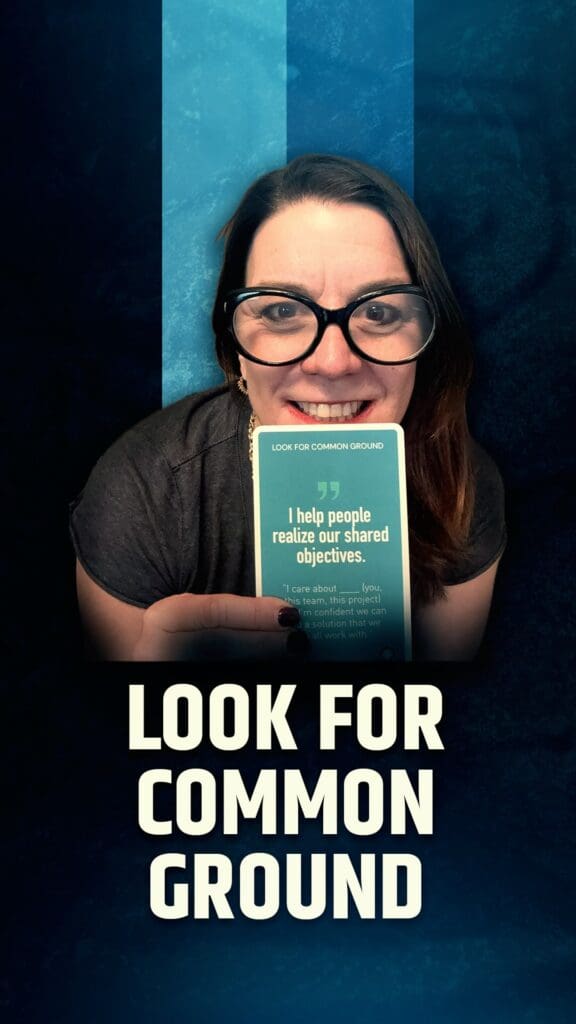
In a world where remote teams, pressure-cooker deadlines, and opposing viewpoints collide daily, the ability to find common ground is what keeps collaboration from falling apart.
When you focus on what unites you:
- People start listening (not just waiting to speak).
- Defensiveness drops. Engagement rises.
- The conversation becomes about solutions—not sides.
This isn’t about being “nice” or smoothing things over. Finding common ground doesn’t mean compromising your values or letting things slide.
It means saying, “Here’s what matters most—and I believe we can get there together.”
It’s one of the simplest and most effective ways to lower the temperature and raise the trust.
How to Find Common Ground Without Sounding Scripted
Here’s how to bring this habit into your everyday conversations—especially the tricky ones.
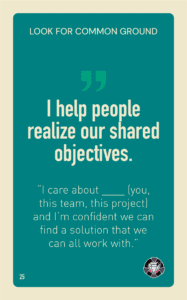
Click here to learn more about our habit based team building system.
1. Say What You Genuinely Care About
“I care about our client relationship.”
“I care about how this affects the team.”
Be specific. Be real. People can spot fake alignment a mile away.
2. Acknowledge the Tension
“We’re looking at this from different angles, but I think there’s a path that works for both of us.”
You’re not dodging conflict—you’re grounding it in connection.
3. Re-center on Shared Intent
“What are we both trying to accomplish here?”
When you find the shared goal, you find common ground.
4. Don’t Pretend It’s All Okay
“What would it take for us to get on the same page?”
Respect doesn’t require agreement. But it does require honesty.
5. Be Firm on Care, Flexible on Form
If you both care about the outcome, you can flex on the how.
More Powerful Phrases to Help You Find Common Ground
Use these when a conversation feels stuck or strained:
- “We both want this to succeed—what would that look like from your view?”
- “Here’s what I want to protect as we figure this out. What about you?”
- “Can we pause and name what we agree on before we go further?”
- “What are we each solving for here?”
- “What matters most to you in this decision?”
Mini-Experiments to Build the Common Ground Habit
 You don’t build a new habit by reading about it. You build it by doing—over time, in real moments, when it collaboration matters. These small, simple experiments are designed to help you find and name common ground more easily when the stakes are high and the pressure is on.
Try one at a time, or rotate through. Each can be done solo—or shared with your team.
1. The Care Clarity Log
Every time a conflict pops up—big or small—pause and ask yourself:
“What do I actually care about right now?”
Then jot it down. One sentence. No overthinking.
At the end of the week, review your list. Patterns will pop up: what really matters to you, what’s worth protecting, and what you keep coming back to. That’s your compass.
2. Pre-Meeting Anchor Phrase
Before a meeting where tensions might flare, write down one sentence that ties what you care about to what you want to see happen.
Examples:
-
“I care about the team’s energy—I want this to feel collaborative, not combative.”
-
“I care about the timeline—I want to walk out with a decision.”
Start your part of the meeting by saying that sentence aloud—or paraphrasing it in your own voice. It quietly sets the tone and nudges everyone toward common ground before things go sideways.
3. Shared Goals Check-In (Team Edition – Try it for a month)
Start your weekly team meeting with this one-liner:
“Let’s name one thing we’re all trying to get right this week.”
Go around. One sentence per person. No deep speeches.
It sounds simple, but it surfaces shared goals early, creates alignment fast, and reduces drama later. (And if someone can’t name a shared goal… that’s a conversation worth having.)
4. The Weekly Reframe (4 Fridays in a row)
Once a week, think back on a tough moment where tension showed up. Ask yourself:
“What was one piece of common ground we could have named that might have helped?”
You don’t have to go back and redo the conversation. But noticing what was there—and missed—trains your brain to look for it next time.
Write it down. Keep a list. Over time, that shift becomes muscle memory.
Remember: Common Ground Isn’t a Shortcut. It’s a Strategy.
You don’t need to wait for the perfect moment. You just need to start from what you care about. Say it clearly. Say it confidently. And say it like you mean it:
“I care about (you, this team, this project), and I’m confident we can find a solution we can work with here.”
That’s how common ground becomes common practice.
See Also; Why Agree to Disagree Stinks: And What to Do Instead


0 Comments