

It’s not the yes that builds trust—it’s what comes after.
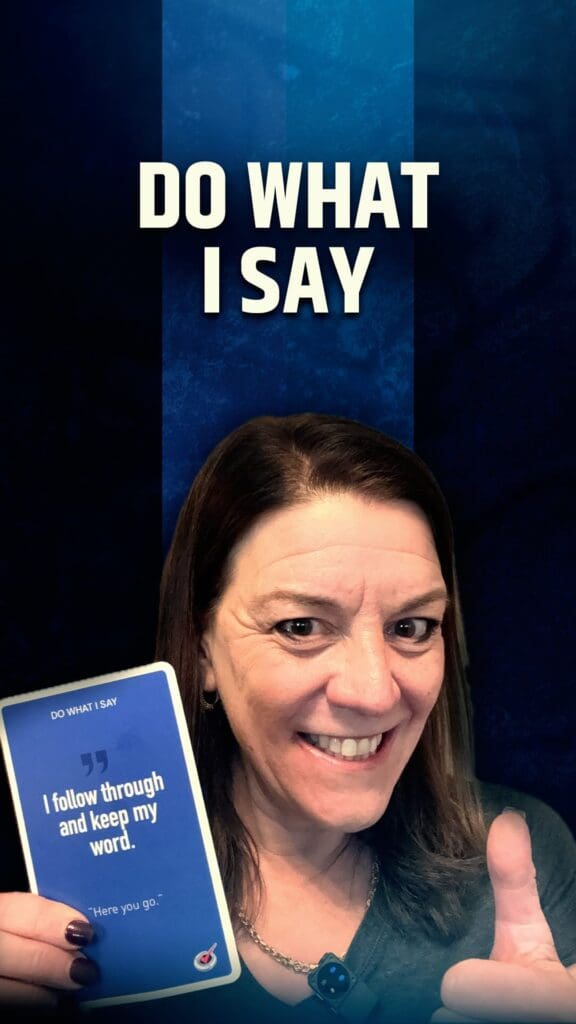
You feel it fast when follow-through starts slipping. Someone says, “I’ve got it.” They don’t. They say they’ll send it. You’re still waiting. In this video, Karin shares why the “do what you say” habit is so important and an easy way to get more accountability from your team.
And then in the article that follows, we offer more ways to increase your follow-through factor, including some mini-personal experiments and powerful phrases.
How to Build More Follow-Through With Your Team (With Video)
Why Follow Through is So Important
Practicing the “Do What You Say” habit means you treat every commitment like it matters—because it does.
You…
- keep your agreements visible, measurable, and complete.
- don’t drop the ball quietly
- don’t overpromise to move a meeting along
- don’t leave people wondering if they need to follow up.
You say you’ll do it—and then you do. Fully, clearly, and on time.
That’s the habit. Not just saying yes. Living yes.
IMPORTANT NOTE: You can’t really nail the “do what you say” habit without getting good at saying no, more here.
The more you practice Do What You Say, the more trust you earn—and the less effort people need to spend managing around you.
Why the Do What You Say Habit Slips—Even with Good Intentions
You didn’t mean to drop it. You just got buried. Something mission critical came up. The day spun out. It felt small, or you assumed it could wait.
But what you meant to do doesn’t matter when someone’s waiting on what you said you’d do.
The real danger? People may not call you out. They’ll just adjust. Or put it in the metaphorical “diaper genie” and stop counting on you for the important stuff.
And when you only follow through most of the time, people assume it might not happen this time.
That’s why Do What You Say only works when it’s consistent. Of course if you need to re-prioritze– people know you will come to them to renegotiate your new scheduled finsih.
How to Make Do What You Say a Habit That Sticks
You don’t need to be perfect. But you do need to be accountable. And visible. And never blind side when best intentions break down.
Here’s how to make Do What You Say part of how you work:
1. Track every commitment you make—no matter how small.
If you say, “I’ll send that over,” write it down. If you say, “Let me get that to you by Friday,” capture it. Memory is not a system.
2. Confirm the scope.
What does “done” mean? Ask if needed. Don’t assume. Do What You Say includes delivering what was asked for—not just something.
3. Schedule the finish– Set a real delivery target—and name it.
Don’t say “soon.” Say “by 3PM tomorrow.” Lock in the timeline so you—and they—know when to expect it.
4. Deliver fully and on time (or renegotiate)
Not almost. Not “close enough.” If you can’t deliver exactly what you promised, reset expectations clearly and early.
5. Make the follow-through visible.
Don’t assume they saw it. Send the file, ping the thread, or say, “Here you go.” That’s not just a phrase—it’s the moment the loop closes.
Powerful Phrases To Reinforce
-
“Here you go—delivered as promised.”
-
“Circling back with exactly what we agreed to.”
-
“This should match what we talked about. Let me know if anything’s off.”
-
“I’ve got that done. On time and to spec.”
-
“Wanted to close the loop on this—sent what I committed to.”
Three Mini-Personal Experiments to Build the “Do What You” Say Habit
 Here are few mini-personal experiements you (or your team) can commit to for the next 30 days to help ingrain the habit. Learn more about mini-personal experiments here.
1. The Commitment Ledger
For two weeks, write down every single promise you make—verbally, over Slack, in meetings, in passing.
Every night, review the list. Did you deliver what you said you would, when you said you would?
Then ask: Was it to spec? Was it on time? Was it visible?
Start noticing the patterns—especially the small ones.
2. Define “Done” Before You Start
Every time you agree to do something this month, ask:
“Just to confirm—what does success look like on this?”
Write down the answer. Use it as your delivery spec.
This simple check turns fuzzy promises into deliverables you can actually follow through on—and builds trust every time.
3. Close One Loop a Day—No Matter What
Before you log off each day, pick one open commitment and close it.
>Even if it’s late. Even if it’s awkward. Even if it’s a small thing.
Consistency here builds muscle memory. And that consistency is what Do What You Say is built on.
When you practice the Do What You Say habit, you don’t just build reliability.
You build identity.as someone who delivers.
You say it, Do it. Prove it.
And follow through and keep your word,
Note: The Do What You Say Habit is part of our SynergyStack® Team Development System. If you’re a leader looking for easy to use team-building activities to take your team to the next level, or an HR leaders looking for certification, let’s talk more. Contact us here.




0 Comments