
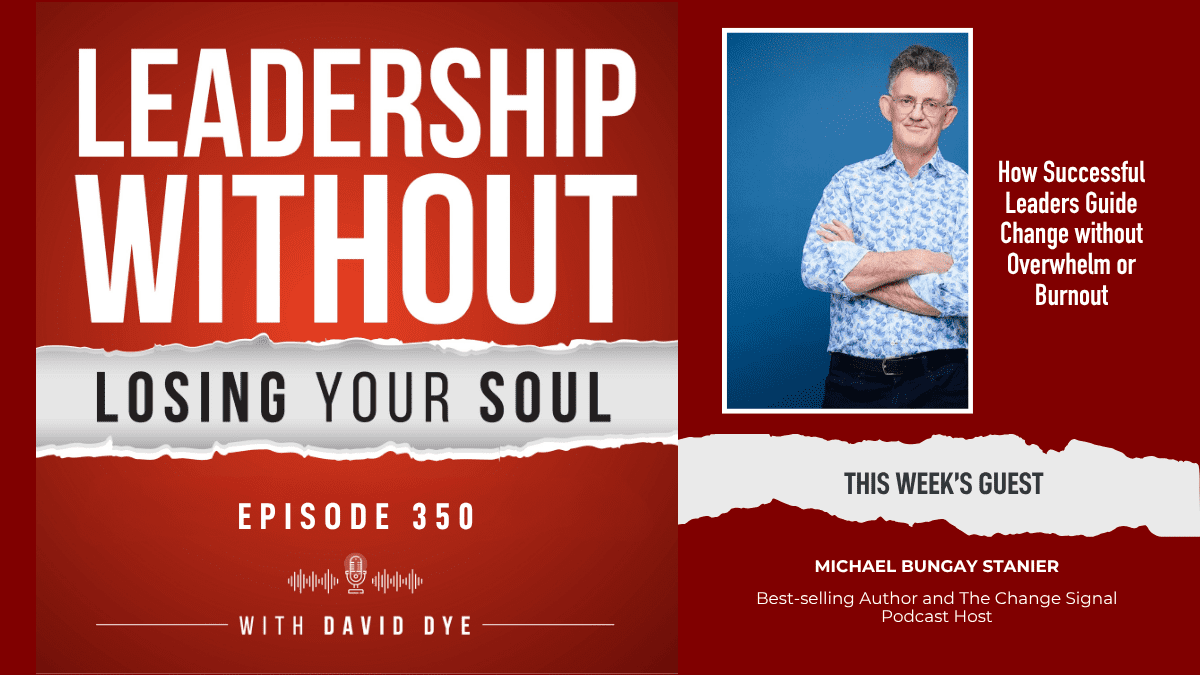

Episode 350: Are you still trying to guide change like it’s a one-time project—while your team is drowning in nonstop disruption?
You’re not imagining it—change really is harder now. The pace has accelerated, resistance is higher, and most initiatives fail not because of bad ideas, but because leaders are using outdated approaches. This episode speaks directly to the pressure you feel: how do you lead change when your team is overwhelmed, skeptical, and stretched thin? Instead of forcing change onto people, you’ll learn how to rethink your entire approach so change becomes something your team can actually navigate—and even support.
David welcomes best-selling author and The Change Signal Podcast host Michael Bungay Stanier to help you:
- Learn how to build real buy-in by creating shared ownership instead of pushing top-down mandates
- Discover how to increase your team’s capacity for change without adding more overwhelm
- Understand the modern “rules of change” so you can lead transformation with less resistance and more success
Hit play now to learn how to guide change in a way that actually works—and finally turn constant disruption into a leadership advantage.
Rethinking How You Guide Change in a Constantly Shifting World
- 00:00 – The episode opens with a powerful premise: leadership is change, and if you want a better tomorrow, you must learn how to guide change effectively in today’s fast-moving environment.
- 02:25 – You hear the uncomfortable truth—up to 85–95% of change initiatives fail, while employees face more change than ever and are less willing to embrace it.
- 06:00 – A key mindset shift: change is no longer a one-time initiative—it’s part of everyone’s job description, requiring leaders to continuously build adaptability.
- 07:00 – The idea of distributed agency is introduced—successful leaders guide change by giving people ownership and encouraging small, low-risk experiments.
- 10:00 – The paradox of empowerment: to guide change well, you must give up control—accepting messiness, unpredictability, and imperfect execution.
Practical Strategies for Leading Change Without Burning Out Your Team
- 12:00 – Organizational capacity becomes critical—leaders must stop piling change on already overwhelmed teams and instead create real space to support transformation.
- 15:30 – Feedback as data: teams are more willing to engage when they can share what’s working (and what’s not) without fear of punishment.
- 18:10 – Senior leaders play a pivotal role by setting a compelling vision, playing the long game, and simplifying priorities to help teams guide change effectively.
- 22:00 – Technical excellence matters—poor communication and weak internal messaging can derail even the most important change efforts.
- 27:30 – Middle managers aren’t powerless—you can guide change from where you are by building stronger working relationships and proactively shaping how you collaborate with your boss.



0 Comments