
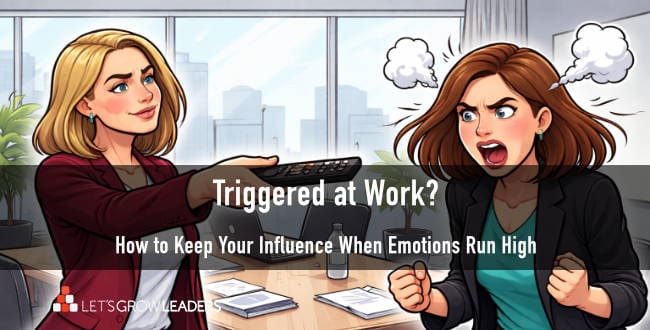
When Someone Pushes Your Button, Don’t Hand Them the Remote
Practical tips to manage your emotional responses when you’re triggered at work.
I watched it happen like a car wreck in slow motion. Two executives (one’s the boss). A long history. A room full of peers. And that unmistakable energy in the air that says, Oh no. Here we go.
They’ve known each other for years—the kind of relationship where you don’t just know someone’s strengths. You know their sensitivities. Their hot buttons. The exact words that will light the fuse.
And in front of several colleagues—people who matter—the boss says the triggering words.
The phrase is almost casual, tossed out like it’s no big deal. But it isn’t casual. It’s calibrated. It lands exactly where the boss knows it will land.
The recipient of the triggering words (let’s call her Jane) pauses for half a second.
Jane’s eyes change. Her shoulders tighten. Her face shifts. And then she loses it.
Jane is triggered.
Jane’s reaction comes fast. Her volume climbs. Her executive presence—gone. She undermines her influence in the very room where she needs it most.
And the worst part?
I don’t just feel secondhand embarrassment. I feel recognition. Because I’ve been her. Maybe you have too.
There are moments when you’re doing fine—leading, listening, contributing—and then someone says something demeaning or dismissive or dehumanizing… and your body reacts before your brain can protect you.
Your face gets hot. Your throat tightens. And, your words get sharper.
And later, when you’re alone, you think:
“Ugh. That is not how I wanted to show up.”
So let’s talk about what I wish every leader understood about being triggered at work—especially at senior levels—because managing emotions isn’t a soft skill. It’s a power skill.
First: Don’t trigger people on purpose.
Let’s name what happened in that room. When a leader intentionally uses triggering words, tone, or humiliation to set someone off—especially in front of others—that’s not “high standards.” That’s not “accountability.” That’s emotional sabotage.
And it’s destructive in all the ways that matter:
It….
-
erodes trust
-
teaches people that dignity is optional
-
makes everyone watching quieter and more careful
-
turns meetings into theatre instead of problem-solving
In our Courageous Cultures research, one truth comes up over and over:
People can’t do their best work in environments where they don’t feel safe as human beings.
5 Tools to Keep Your Power When You’re Feeling Triggered at Work
Because whether or not leaders should bait you… Some will. And when they do, you have a choice on how you respond.
1. Name it privately: “I’m triggered.”
Not out loud (unless you’re skilled and want to say it). But in your own head.
Because naming what’s happening creates a gap between the trigger and the reaction.
Try this:
-
This is a trigger.
-
My body is reacting.
-
I don’t have to respond the way they expect.
That tiny sentence is the first step to staying in charge of yourself.
2. Slow your body down before you speak
Your body goes fast when you’re triggered. So your job is to go slow.
Two quick tools you can use in the moment:
-
Drop your shoulders. (Signals safety to your nervous system.)
-
Exhale longer than you inhale. (4 seconds in, 6–8 seconds out.)
Do it twice.
You’re telling your brain that you’ve got this.
Because your body doesn’t know the difference between “humiliated in a meeting” and “physically threatened.” It just knows threat.
3. Buy time with a dignity-preserving phrase
You do not have to respond instantly.
In fact, the fastest way to lose influence is to respond instantly when you’re triggered.
Try:
-
“Let me think about that for a moment.”
-
“I want to respond thoughtfully, not quickly.”
-
“Can you say more about what outcome you want here?”
-
“Help me understand what you’re asking for.”
Those phrases do two things: they slow the movement, and they keep you looking like a leader, not a reactor.
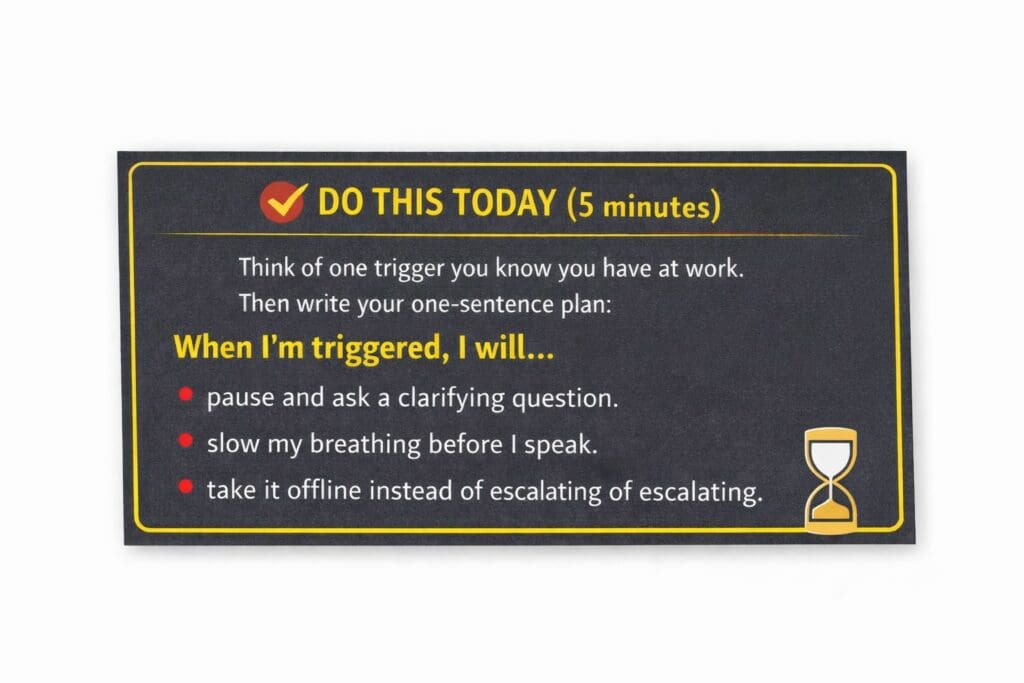
4. Redirect to purpose, not personalities
Triggers pull you into identity and emotion.
Leadership pulls you back to purpose and outcomes.
Try:
-
“Here’s what I’m focused on solving…”
-
“The goal is X. Let’s stay with that.”
-
“What matters most right now is…”
-
“Let’s talk about the decision we need to make.”
Purpose is kryptonite to provocation.
And it keeps you from giving the other person what they want: a performance.
5. Take the exit ramp
Sometimes the most powerful move is not saying one more word.
Try:
-
“This deserves a private conversation.”
-
“I’m not going to have this conversation in this format.”
-
“I’m going to step out and come back when we can address this productively.”
This isn’t avoidance. It’s boundaries.
And it’s the fastest way to stop the spiral.
If you got triggered anyway: Repair fast without groveling 
If you did lose it, don’t turn it into a shame spiral.
You’re human.
But do repair quickly—repairs build credibility.
Here’s a script that keeps your dignity:
“I want to address how I showed up in that moment. I got triggered, and my tone didn’t reflect my best leadership. I’m owning that.
What I meant was this: ______.
And going forward, here’s what I’m committed to: ______.”
That’s not an apology tour.
That’s executive presence.
The leadership moment no one talks about
Courageous leaders can lead even when someone is trying to provoke them.
So if you’ve ever been triggered at work, here’s the reminder I want you to take with you:
The goal is to stay so grounded in your values that even when someone tries to light the fuse, you don’t hand them your power.
Your turn. What would you add? What advice do you have for someone who is feeling triggered at work?
Are you looking for more ways to de-escalate conflict, increase influence, reduce stress, and improve collaboration? Check out our book, Powerful Phrases for Dealing with Workplace Conflict: What to Say Next to De-Stress the Workday, Build Collaboration and Calm Difficult Customers.


wonderful, doable advice, thank you.
Thanks, Cathy! I’m glad you found it helpful.
Thank you for this reminder. I have your book and love it. Life happens, jerks come along, and the opportunity for a knee-jerk response when we have the restraint of our responses. What a great reminder.
Additionally, outside of leadership, in life relationships, this is such a great tool. It’s all more effective, People Work!!!
Thanks
Thanks so much, Kathryn! I’m glad you are finding our book helpful.