
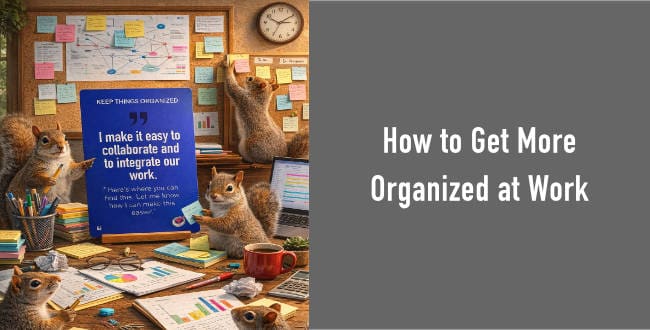
It’s not just what you deliver—it’s how easy it is to work with you.
You might be doing excellent work. But if no one can find it… If file names are cryptic, folders are a mess, and links are scattered, collaboration slows down, no matter how brilliant the ideas are. That’s why you practice the Keep Things Organized habit.
Because making your work easy to navigate makes it easier to use.
And that turns individual effort into shared progress.
Sometimes, it sounds like:
“Here’s where you can find this—let me know how I can make things easier.”
What It Means to Practice the Keep Things Organized Habit (See Video to the Right)
When you practice Keep Things Organized, you’re not just creating for yourself—you’re creating for the team.
You’re thinking a step ahead:
“What will they need to use this? Find this? Build on this without me?”
You keep files, notes, and systems findable, shareable, and named like a human.
>>You lower the friction in how people work with you.
It’s not about being a perfectionist—it’s about being accessible.
Why Keep Things Organized Builds Real Leverage
Good organization isn’t just a personal habit. It’s a team advantage.
When you keep your work clean and clear:
-
People can pick up where you left off
-
Collaboration speeds up (because no one’s digging through six links)
-
Decisions are better informed
-
Institutional knowledge sticks around
-
You become known as someone who makes work easier—not harder
That’s how you build real trust and real momentum.
Why Keep Things Organized Gets Overlooked
When you’re in execution mode, it’s easy to think, “I’ll clean this up later.”
Or, “I know where it is, so it’s fine.”
But your future self isn’t your only collaborator.
Practicing Keep Things Organized means remembering that your work lives in an ecosystem.
People need to find it, use it, and build from it.
And when they can? The whole team moves faster.
How to Make Keep Things Organized a Real Habit
This isn’t about color-coding every doc. It’s about creating shared clarity.
Here’s how:
1. Use your phrase.
“Here’s where you can find this—let me know how I can make things easier.”
It turns delivery into collaboration.
2. Name things like someone else will read them.
Because they will. Use clear, human file names and folder logic.
3. Centralize the source of truth.
Don’t scatter updates across email, Slack, and docs. Point to one place.
4. Overcommunicate access.
Drop the link. Say what’s in it. Mention when it was last updated. Assume nothing.
5. Ask what’s working—and what’s not.
Great organization is about usability, not control. Be open to redesign.
Phrases That Reinforce the Keep Things Organized Habit
-
“I added everything to the shared folder—it’s all labeled by date and topic.”
-
“Let me know if there’s a better way to structure this for the team.”
-
“Here’s the one doc we’re using as the source of truth.”
-
“I just updated the tracker—highlighted what’s new since last week.”
-
“Want me to clean this up a bit before we share it out?”
Three Personal Experiments to Build the Keep Things Organized Habit
1. The Source of Truth Rule
For the next 2 weeks, every time you share work, name the single source of truth.
Link it. Label it. Own it.
Then ask: “Would someone else know where to go next?”
2. Ask for a Cold Read
Have a teammate open one of your files without context.
Can they navigate it? Understand it? Use it?
Whatever confused them—fix it before the next person hits the same wall.
3. The Friday Clean-Up Ritual
End each week with 15 minutes of cleanup.
Archive old links. Rename vague files. Resurface what people might need next.
This turns maintenance into momentum.
When you practice Keep Things Organized, you stop being the only person who can use your work.
You create clarity, speed, and ease—
For everyone.
“Here’s where you can find this—let me know how I can make things easier.”
“Keep things organized” is a commitment habit in our SynergyStack® Team Development System. If you’re looking for easy-to-facilitate team-building activities, learn more about the SynergyStack here.





0 Comments