

Don’t Save Your Appreciation for the Memorial
When someone you worked with and care about dies, grief comes in waves.
You grieve for the human and their contributions to the world, personally and professionally. The unfinished conversations. Moments you assumed you’d have later.
Today, I’m grieving all that. And… something else entirely.
The fact that some people finally say the truest appreciation for someone only after they’re gone.
My Friend
Recently, a colleague and friend I worked with for many years passed away. I WAS NOT surprised to hear the WAVE OF APPRECIATION from her peers, direct reports, friends, and suppliers. She made a huge impact in so many ways.
She was an amazing human-centered leader with a deep capacity to connect and serve.
What did surprise (deeply trouble) me was this.
An executive shared beautiful, specific, heartfelt words about her leadership and contributions.
I heard it through the grapevine. It hit me like a punch in the chest.
Because I knew: my friend didn’t know.
She spent years worrying she wasn’t perceived well… worrying her job was at risk… worrying she wasn’t doing enough.
She didn’t know how valued she was by that leader.
Not because she wasn’t. But it wasn’t unmistakably clear.
If you’ve ever worked under a leader whose style leaves you guessing, you know precisely what that uncertainty does to you.
It turns normal feedback into threat. Makes silence feel like disappointment. Causes you to interpret every meeting invite like a summons.
It’s exhausting.
And it’s avoidable.
The hidden tax of “you don’t really know where you stand”
Some leaders don’t mean to lead with fear. They’re not cruel. They might even deeply appreciate you.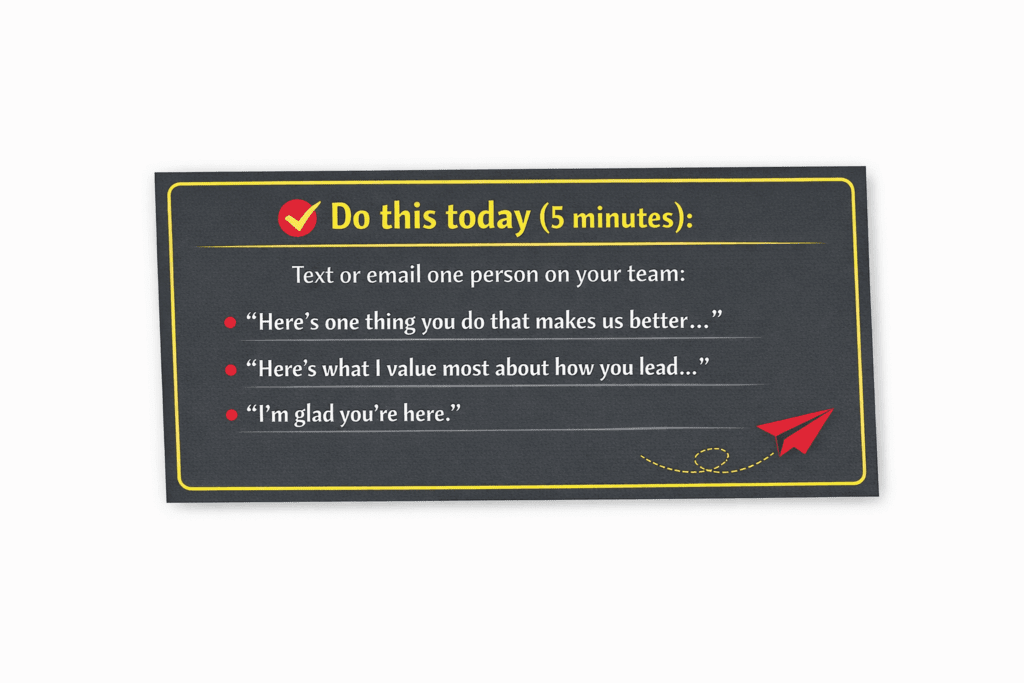
But their default setting is:
-
“I’ll tell you if there’s a problem.”
-
“I don’t want people getting complacent.”
-
“It’s my job to point out what needs fixing.”
-
“Praise makes people soft.” (Yes, some still believe this.)
So what they create—without intending to—is a workplace where people survive by:
-
staying hypervigilant
-
interpreting neutral comments as criticism
-
working twice as hard to avoid getting “noticed”
In our research for our book, Courageous Cultures, we saw it again and again: fear shrinks people.
And when people shrink, innovation shrinks, collaboration shrinks, and energy shrinks.
You don’t get micro-innovators and customer advocates from a culture of ambiguity and withheld encouragement.
You get over-functioners, second-guessers, and silent strugglers.
The tragedy: Appreciation that arrives too late
The executive who spoke so warmly after my friend’s death wasn’t faking it. I believe she meant it.
But here’s the leadership moment I can’t shake:
What if my friend had heard those words while she was alive?
What if she’d had ten more years of confidence and peace?
What if she’d stopped carrying the burden of “I’m not sure I’m enough”?
We talk a lot about performance improvement.
But we don’t talk enough about how leaders unintentionally create unnecessary suffering.
And that’s what this is.
Not malice.
Suffering.
You get more of what you celebrate (and more fear where you stay silent)
We’ve talked about this, and I know you know: you get more of what you encourage and celebrate—and less of what you ignore.
And here’s the part many leaders miss: if your reactions make people afraid, they’ll start managing you instead of managing the work.
They’ll scan your mood. They’ll edit their updates. They’ll work around you rather than with you.
Not because they’re dishonest—because they’re trying to stay safe.
That’s when you get:
-
silence instead of early warnings
-
agreement instead of real debate
-
polished updates instead of honest ones
-
less risk-taking and fewer new ideas
-
more stress, more overwork, and more burnout
Leaders may never say, “I want people to be afraid.”
But if your people are constantly guessing where they stand, fear fills in the blanks.
A human-centered leadership practice: Let people know where they stand
If you lead people, you owe them more than an annual review and occasional constructive feedback.
You owe them clarity.
Not “be nice” clarity.
Be real clarity.
Here are three simple, practical ways to make sure people don’t wonder where they stand.
1) Make encouragement as specific as your critique
If you can give detailed feedback on what needs to improve, you can give detailed feedback on what’s working.
Try this:
-
“Here’s what I’m counting on you for… and you’re delivering.”
-
“The way you handled that conversation saved us time and drama.”
-
“Your leadership is making this team better.”
Specificity makes appreciation credible.
2) Balance Appreciation and Corrective Feedback (especially when pressure is high)
Under stress, many leaders flip into “error detection mode.”
But if people mostly hear what’s wrong, they start to believe they’re wrong.
Aim for a balance or encouragement for every correction (not in the same sentence). Not because you’re trying to be fake—but because you’re trying to be fair.
3) Close the loop: “Here’s where you stand with me.”
This is the sentence so many people need but never hear:
-
“You’re doing well, and I value you.”
-
“Your job is not at risk.”
-
“I’m glad you’re on this team.”
Say it out loud.
Don’t assume they know.
Silence is not neutral. Silence is a story generator.
And your people will usually write a scarier story than you ever intended.
If you’re an executive, this is your courageous leadership moment
Leading with fear is lazy leadership.
It’s easy to critique.
To point out what’s missing.
To let people guess and call that “high standards.”
Courageous leadership requires something else:
The courage to:
Name what’s working.
Recognize value in real time.
Let people feel safe enough to do great work.
You don’t lower the bar by celebrating.
You raise the ceiling.
The question I can’t stop asking
What if more people knew, while they were alive, how much they mattered?
So here’s your nudge.
Think of someone who is quietly carrying the weight of uncertainty.
Someone who works hard, tries, contributes, and leads.
And tell them. Today.
Not in a performance review.
Or at the retirement party.
Before the memorial.
Now.
Because a courageous culture isn’t built by big speeches after someone is gone.
It’s built on everyday moments of truth while they’re still here to hear it.

Thank you for writing this piece and for the accuracy and heartfelt intent. It needs to be said more and more importantly displayed more across leadership behaviors. Thank you!
Thank you, Jonathan. I appreciate you and how consistently you show up as a human-centered leader, particularly during difficult times.
The difference this could make in so many workplaces is palpable. Each one of us who decides to take this forward brings our world closer to the tipping point where human-centered leadership becomes the norm, rather than the exception. Bravo. My condolences on your loss.
Thanks so much, Kenya! I agree —this happens one by one with the choices we make. I appreciate you expanding the conversation.