
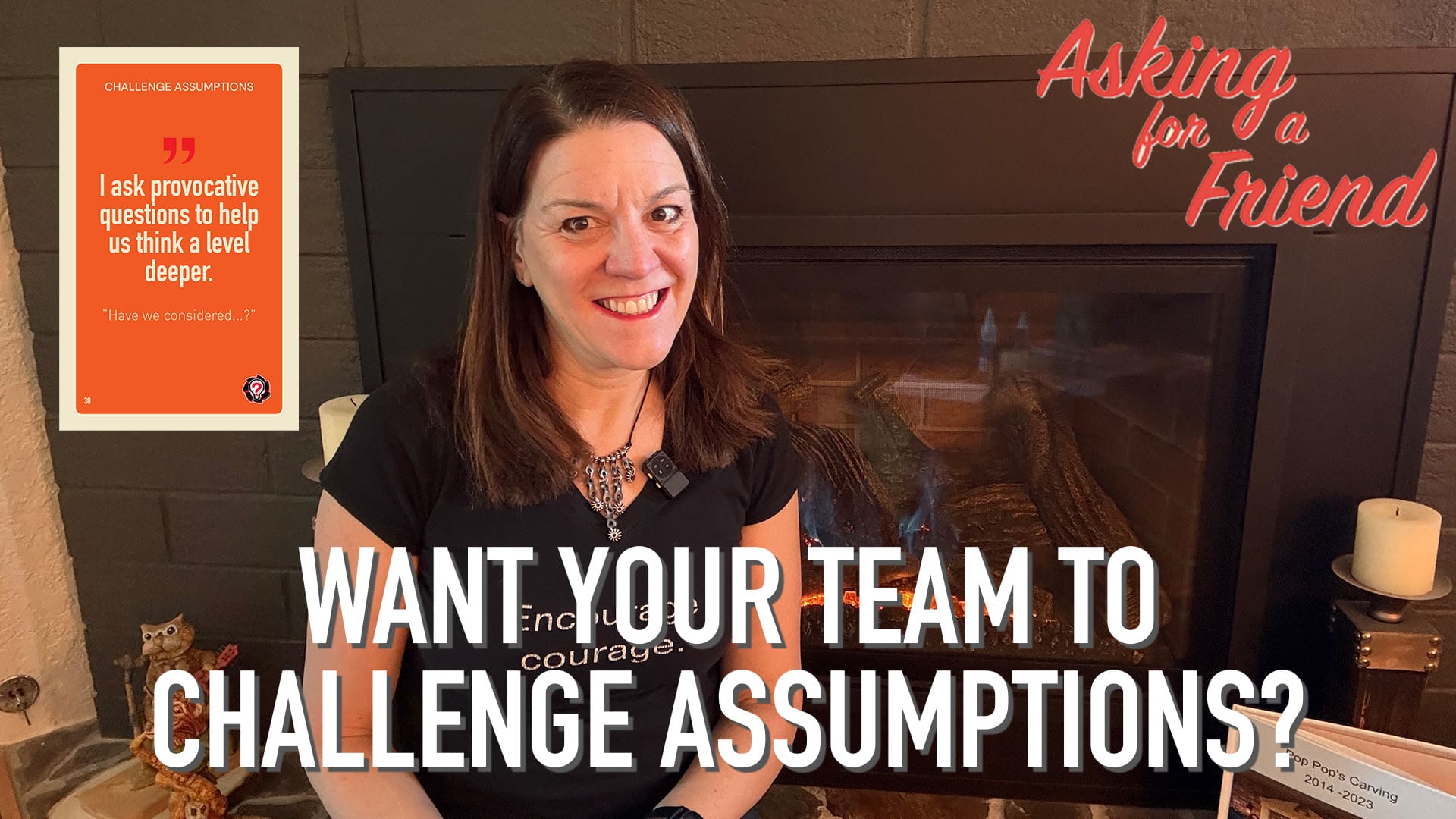

Challenge Assumptions to Improve Decisions, Innovation, and Trust
Transform your team’s decision-making by challenging assumptions.
Break free from narratives that limit innovation and growth.
“My team is smart, experienced, and well‑intentioned. The problem? They make a LOT of assumptions.
We assume customers won’t want something new. We assume leaders will shoot down ideas. We assume employees will resist change.
Intuition matters—but how do I help my team challenge their assumptions without dismissing their experience or slowing everything to a crawl?” #AskingforaFriend
Great question. The more subtle (and dangerous) assumptions are the invisible ones—the stories we tell ourselves about how people will react.
Let’s talk about how to keep intuition and introduce discipline, so your team doesn’t confuse confidence with certainty
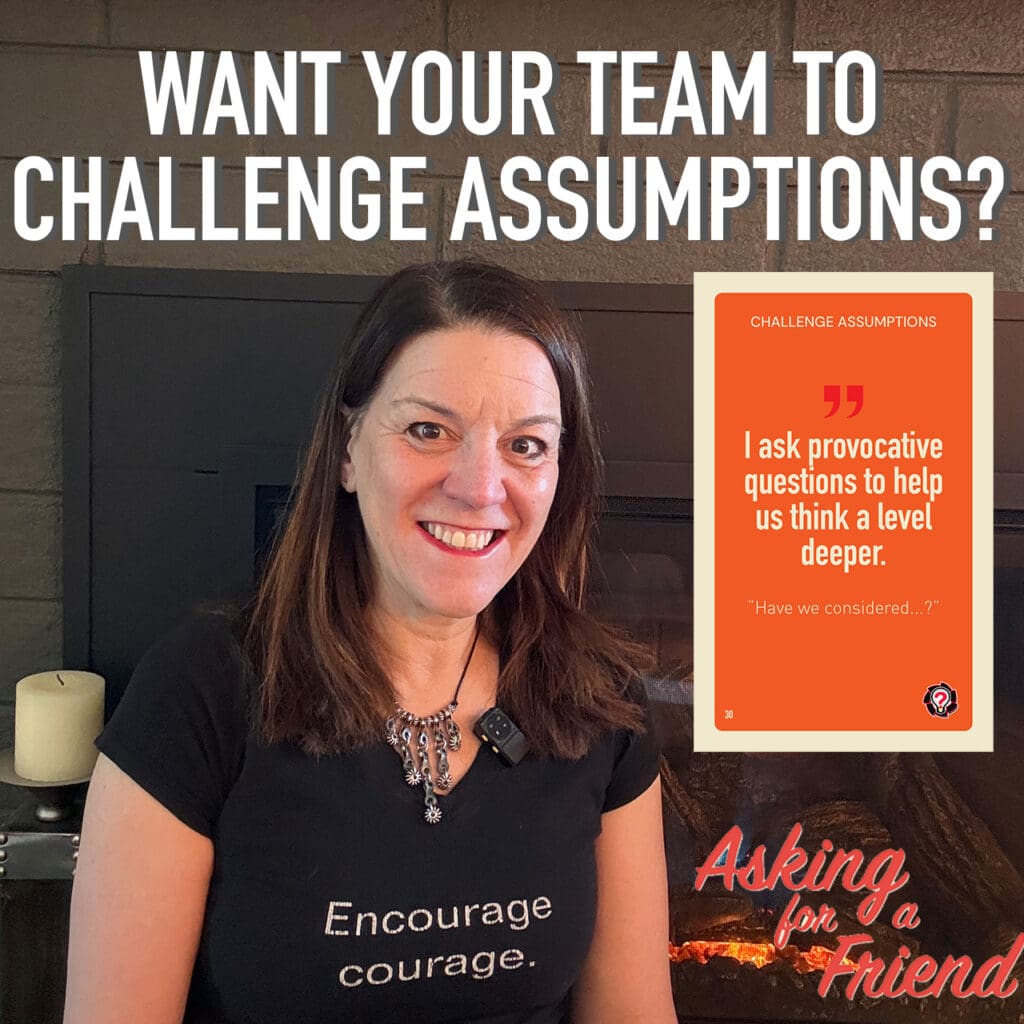
Watch this video for more tips on helping your team challenge assumptions
Why Assumptions Are So Comfortable (and So Risky)
Assumptions feel efficient. They help your team move fast and protect themselves from risk.
But here’s the problem:
When assumptions go unchallenged, they quietly become decisions.
- “Customers won’t pay for that” becomes we won’t test it.
- “Leadership won’t support this” becomes we won’t propose it.
- “Employees will hate the change” becomes we won’t explain the why.
That’s not intuition—that’s untested storytelling.
A Powerful Way to Challenge Assumptions (Without Shutting People Down)
In our book Courageous Cultures, we share a practice that shows what assumption-challenging looks like when it’s done well.
Jill Herr, a director of clinical operations at WellSpan Health, calls it The Patient Perspective.
Instead of a generic devil’s advocate, their teams formally assign one person to represent the patient during key meetings. When it’s your turn, you don’t weigh in from your usual role or expertise.
Your entire job is to ask—and answer—one question:
“As the patient, what would I want? What would I say?”
They used this practice while designing an electronic documentation and scheduling system in an acute-care environment. The original goal was operational efficiency—making sure departments didn’t all arrive to see the same patient at once.
During one meeting, the person representing the patient raised a hand and said:
“I want to know my schedule too. I want to know when my doctor is coming. My family wants to know when therapy is happening so they can be here to be involved.”
That single comment surfaced a huge, invisible assumption:
- This system is just for staff coordination.
The result was a shift toward transparent scheduling—still a work in process, but one that made a meaningful difference in the patient experience.
This is what disciplined curiosity looks like. Perspective isn’t a side comment—it’s the job.
Keep Intuition—But Make It Earn Its Keep
Intuition does matter. Experience counts. Patterns are real.
The goal isn’t to eliminate intuition—it’s to interrogate it.
Here are practical, respectful ways to help your team challenge assumptions without shutting people dow
1. Name the Assumption
Most assumptions operate undercover.
Try these Powerful Phrases:
- “What are we assuming here?”
- “What would have to be true for this to fail?”
- “Is that a fact—or a prediction?”
Normalize assumption‑spotting as a team skill, not a personal critique.
Celebrate the person who surfaces the assumption—even if you don’t like what it reveals.
2. Separate Data from Story
When someone says:
“Our customers won’t go for that.”
Coach the distinction:
- Data: What have we actually seen, heard, or measured?
- Story: What meaning are we adding based on past experience?
Both are valuable—but they are not the same thing.
Try this prompt: “What data are we using—and where are we filling in the blanks?”
3. Use Small Experiments Instead of Big Debates
Assumptions love conference rooms. They hate experiments.
Instead of arguing about how people will react, ask: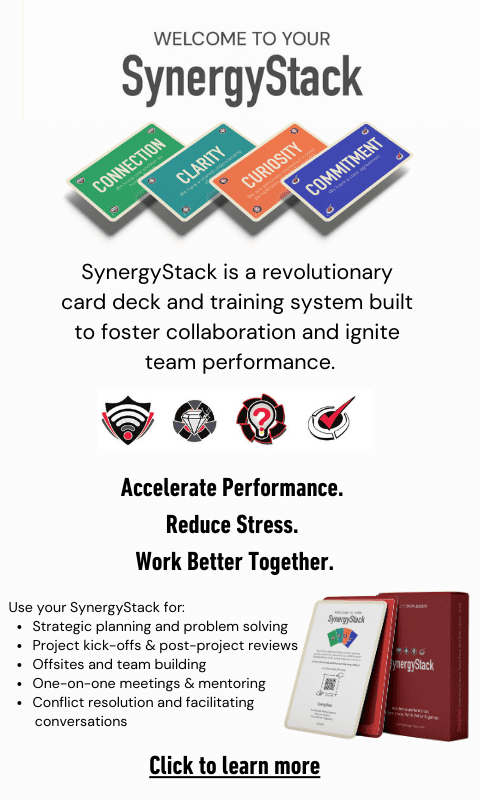
- “What’s the smallest way we could test this?”
- “Who could we ask before we decide?”
- “What pilot would give us real feedback?”
You don’t need a massive rollout to learn something useful.
5. Pressure‑Test with Multiple Perspectives
Encourage your team to finish this sentence in different ways:
- “From a customer’s point of view…”
- “If I were a frontline employee…”
- “If I were hearing this for the first time…”
Assumptions shrink when perspective expands.
6. Reward Learning, Not Just Being Right
If people get punished for being wrong, they’ll cling to assumptions that feel safe.
Publicly recognize:
- Smart tests that disproved a belief
- Teams who changed direction based on feedback
- Leaders who said, “I was wrong—and here’s what we learned”
That’s how you build a culture where curiosity beats certainty.
Assumptions are a human shortcut.
Your job as a leader isn’t to eliminate them—it’s to slow them down just enough to ask:
“How do we know?”
When intuition is paired with curiosity, your team doesn’t just avoid mistakes—they uncover better ideas, braver solutions, and smarter risks.
And that’s a future worth challenging assumptions for.
Note: Challenge Assumptions is one of the Curiosity Habits in our SynergyStack® Team Development System. If you’re looking for a high-impact, easy-to-use, low cost teambuilding solution. Learn more here.



0 Comments